Congressional -
            Executive Commission on China
  Home     Search     Printer Friendly Subscribe/Unsubscribe to
Commission Email & Newsletter


View the
Complete Report
(Adobe Acrobat PDF)
View the
Press Release

CONGRESSIONAL-EXECUTIVE COMMISSION ON CHINA

2005 ANNUAL REPORT

III. Monitoring Compliance With Human Rights

III(d) FREEDOM OF RELIGION

Introduction | New Regulation on Religious Affairs | Government Persecution of Falun Gong | Religious Freedom for Tibetan Buddhists | Religious Freedom for China's Catholics and China-Holy See Relations | Religious Freedom for China's Muslims | Religious Freedom for China's Orthodox Christians | Religious Freedom for China's Protestants

FINDINGS

  • The Chinese government continues to harass, abuse, and detain religious believers who seek to practice their faith outside state-controlled religious venues. In 2005, the government and Party launched a large-scale implementation campaign for the new Regulation on Religious Affairs to strengthen control over religious practice, particularly in ethnic and rural areas, violating the guarantee of freedom of religious belief found in the new regulation.
  • The religious environment for Tibetan Buddhism has not improved in the past year. The Party demands that Tibetan Buddhists promote patriotism toward China and repudiate the Dalai Lama, the religion's spiritual leader. The intensity of religious repression against Tibetans varies across regions, with officials in Sichuan province and the Tibet Autonomous Region currently implementing Party policy in a more aggressive manner than officials elsewhere. Sichuan authorities sometimes impute terrorist motives to Tibetan monks who travel to India without permission.
  • The Chinese government continues to repress Catholics. Chinese authorities are currently detaining over 40 unregistered clergy and have taken measures this year to tighten control of registered clergy and seminaries. Despite assurances of its desire to establish diplomatic relations with the Holy See, the Chinese government has not altered its long-standing position that, as a precondition to negotiations, the Holy See must renounce a papal role in the selection of bishops and break relations with Taiwan.
  • The government continues to strictly regulate Muslim practices, particularly among members of the Uighur minority. All mosques in China must register with the state-run China Islamic Association. Imams must be licensed by the state before they can practice, and must regularly attend patriotic education sessions. Religious repression in Xinjiang is severe, driven by Party policies that equate peaceful Uighur religious practices with terrorism and religious extremism.
  • In the past year, the Chinese government continued a campaign begun in 2002 focused on harassing and repressing unregistered Protestant groups and consolidating control over registered Protestants. Hundreds of unregistered Protestants associated with house churches have been intimidated, beaten, or imprisoned. The Chinese government opposes the relationships that many unregistered Protestant house churches have developed with co-religionists outside China.

Introduction

Religious believers in China practice their faith in the shadow of government and Party propaganda, control, and harassment. Believers who choose to worship outside state-controlled venues face detention or arrest, and in some cases police abuse. Such repression, while not uniform across China, has created an atmosphere of anxiety and unpredictability for most Chinese believers. The new Regulation on Religious Affairs (RRA),1 which took effect in 2005, requires local religious affairs officials to "standardize" the management of religion. As a result, local officials measure their success in terms of the number of unauthorized religious venues that they merge, correct, or shut down, or the number of unregistered believers detained and arrested.2

New Regulation on Religious Affairs

Government officials initially emphasized that the RRA would liberalize state management of religious affairs, but they subsequently stressed the aspects that strengthen state control. At an international conference in 2004 that took place before the RRA was implemented, Zhang Xunmou, head of the policy and legal department of the State Administration of Religious Affairs (SARA), said the new regulation would bring about a "paradigm shift" in the control of religion in China.3 He also predicted that the RRA would set clear limits on official power over religion, safeguard religious freedom, and move from a system of direct bureaucratic control over religion to a system of self-government by religious groups.4 But as the March 1 implementation date drew closer, other senior SARA officials emphasized that the goal of the RRA is to manage religious affairs, and that officials working on religious issues could be held accountable for failing to follow the relevant laws and procedures.5

Central government officials also stressed the importance of using the RRA as a shield against foreign religious influence in meetings held throughout China in early 2005. The Tibet Autonomous Region (TAR) government was among the first to hold such meetings. TAR Vice Chairman Gyara Lobsang Tenzin (Jiare Luosang Danzeng) introduced the RRA in a January 2005 speech in which he emphasized "preventing outside powers from using religion to infiltrate China," and giving religious affairs officials "a lawful method to deal with more complicated religious issues."6 He mentioned protection of religious freedom only briefly.7 Officials also called for using the RRA to guard against "foreign infiltration" at meetings in Yunnan and Jiangsu provinces in February.8 And in an April meeting in Henan province, Zhi Shuping, the Henan Deputy Party Secretary, focused on foreign threats and the danger that religion can destabilize society.9 Zhu also said that, "For those comrades engaged in religious work, the study and implementation of the RRA is a major event; even more, it is a powerful weapon, a one-time favorable opportunity."10

Although the language of the RRA showed early promise, the government implementation campaign this year has emphasized increased control over religion, and reports from U.S. NGOs that monitor religious freedom in China show increased restrictions on registered Christian groups since the RRA was implemented.11 Before the RRA, Chinese law already contained many of the rights and protections for believers found in the new regulations, such as the protection of "normal" religious activities,12 safeguards for religious properties,13 and the right to a democratic election of management organizations for religious venues.14 Such provisions have been largely ineffective in protecting religious organizations from state interference.15

Observers outside China have been divided on the impact of the RRA on religious freedom in China. One U.S. GO representative told a Commission roundtable that the RRA further codifies "the rules restraining religious practice in China and the bureaucratic mechanism used to reinforce those rules."16 An American professor was somewhat less pessimistic, but concluded that "the purpose [of the RRA] is to reduce arbitrariness, but for the purpose of better state control."17 Another U.S. academic expert had a more positive assessment, saying that the RRA shows "an intent to treat religious organizations equally with other social organizations as a normal part of Chinese society and culture."18 A Catholic scholar in Hong Kong saw some benefit in the RRA provisions on religious property and redress against abusive officials.19 Another Catholic analyst noted a few improvements, such as the requirement in Article 15 for officials to respond promptly to applications for registration, protections for religious properties in Articles 30 to 33, and the authorization in Article 34 for organizations to establish social service groups. The analyst expressed concern, however, about the punishments that Articles 43 and 45 imposed against believers and organizations that break RRA rules.20 Other outside observers said the regulation does nothing new.21

Important questions about the RRA remain to be answered. Such issues as whether the government will invoke Article 14 to prevent Protestant churches located close to each other from registering, and whether Articles 8 and 9 permit religious groups to establish religious schools, are of particular concern.22 Since the RRA went into effect, some unregistered Protestants report that authorities have increased harassment of house churches, but registered Protestants report little change.23 For the first time, the RRA authorizes churches and other religious entities to offer social services and raise funds to support them, requiring that the religious entity use any proceeds for "activities commensurate with the aims of the religious organization as well as the relevant social services."24 Article 35 allows religious entities to accept foreign donations to support "activities commensurate" with the entity's goals. The RRA also provides for religious organizations to be governed by the "Regulations on the Management of Registration of Social Organizations" (RSO).25 These regulations impose restrictive and burdensome requirements on social organizations, and do not guarantee organizational autonomy. A Ministry of Civil Affairs official said, however, that the RSO requirement to register with a government sponsor would be loosened in the case of religious organizations.26

The RRA does not clearly restrict either religious organizations or venues for religious activities to the "five categories of religion"¡ªBuddhism, Catholicism, Daoism, Islam, and Protestantism¡ªpermitted by law since 1949.27 Some scholars have interpreted this lack of specificity as a decision to allow new categories of religious practice.28 A senior Chinese academic expert commented that an important current issue is the ambiguous status of the fast-growing "folk" belief systems not included in the five official categories.29 Another Chinese religion expert who advised the drafters of the RRA said the absence of a definition of "religious belief" in the final product shows continuing government caution about expanding the number of recognized religions. The Orthodox Church hopes that the government will permit it to operate in China under the RRA.30 Believers in traditional forms of Chinese "folk" religion, which the Party has long disdained as feudal superstitions, also hope that a category for popular religion may be added to the official five.31

Government Persecution of Falun Gong

Chinese authorities continue to persecute practitioners of Falun Gong and other qigong disciplines that the government has designated "cults." A Party-led anti-cult campaign that targeted religious and spiritual activities in rural areas, including Falun Gong practitioners, continued through late 2004.32 In 2005, the Party continued to campaign across China,33 seeking to persuade the public that the groups labeled as "cults" claim to be religious or spiritual, but in fact are "anti-social." Documents of the "610" offices, which are local government offices that keep track of such groups, reveal an organized bureaucratic scheme for rewarding local officials who uncover, re-educate, and detain practitioners. Officials who fail to perform these tasks receive demerits on their periodic work evaluations. In June 2005, diplomat Chen Yonglin, assigned to the Chinese Consulate General in Sydney, Australia, requested asylum in Australia on the grounds that he would be persecuted for having failed to report and follow up on Falun Gong and dissident activity in Australia.34 Government repression has not succeeded in eliminating Falun Gong in China. Rather, according to a U.S. scholar, it has "shifted the struggle to virtual reality," as repressed groups rely on the Internet to organize and communicate with each other.35

Religious Freedom for Tibetan Buddhists

The environment for the practice of Tibetan Buddhism has not improved in the past year. The Party does not allow Tibetan Buddhists the freedom to practice their religion in a meaningful way, and instead tolerates religious activity only within the strict limitations imposed under the Chinese government's interpretation of the Constitution, laws, regulations, and policies. The Chinese leadership refuses to acknowledge the Dalai Lama's role as the spiritual leader of Tibetan Buddhists.

China's new RRA may lead to more administrative intrusion into Tibetan Buddhist affairs by underscoring the state's right to supervise the effects of religion on society.36 If the RRA leads to further restrictions on teaching and assembly in Tibetan monasteries, on association between the Tibetan clergy and laity, and on small prayer gatherings of the Tibetan laity, the result will further erode the traditionally close ties between the Tibetan monastic and secular communities. Tibetan Buddhism forms the core of self-identity for most Tibetans and is integrated throughout the activities of daily life. Official regulations that interfere with the practice of Tibetan Buddhism harm the Tibetan common identity.

Each Tibetan monastery and nunnery has a Democratic Management Committee (DMC)37 that functions as its administrative interface with the state. Authorities expect DMCs to ensure that monks and nuns obey laws and regulations governing religion, and uphold national and ethnic unity.38 A group of DMC leaders from TAR monasteries completed a training course on the new religious affairs regulations in May 2005. At the closing ceremony, each one pledged individually, "When we go back, we will use the knowledge we have gained in our practical work, further improve the democratic management of our local temples, lead the masses of monks and nuns to love the nation and love the religion, and make more contributions to building a harmonious Tibet."39

The attitudes of DMC members toward religion vary within each monastery and across regions.40 Some DMC members try to facilitate the religious purpose of a monastery by working to maintain a disciplined program of scriptural study, but a shortage of qualified teachers and state control undercut Tibetan monastic study.41 Party and government pressure most heavily affects monasteries and nunneries that follow the Tibetan Buddhist tradition most directly associated with the Dalai Lama, the Gelug.42 Monasteries associated with other traditions, such as the Kargyu, Sakya, and Nyingma, may encounter less official interference in their monastic affairs.43

The intensity of religious repression varies across regions, with officials in Sichuan province and the TAR currently implementing policy in a more aggressive manner than elsewhere.44 According to data available in the CECC Political Prisoner Database (PPD) in June 2005,45 the TAR, the location of the majority of Tibetan political protests from the late 1980s to mid-1990s, holds more than half of the Tibetan political prisoners known to be currently imprisoned. About 60 percent of them are monks. But in recent years, Sichuan province authorities have detained more than three times as many Tibetans for political reasons than either the TAR or Qinghai province. About two-thirds of the Tibetan political prisoners detained from 2002 onward are in Sichuan province, according to the PPD. Half of them are monks. In Qinghai province, there are fewer Tibetan political prisoners than in the TAR or Sichuan province, but all except one of them are monks.

Authorities wary of devotion to the Dalai Lama sometimes accuse monks who travel to India for pilgrimage or religious study without obtaining official permission46 of splittist or terrorist motives. A Chinese public security journal, Policing Studies, reported in 2004 that " 'pro-Tibetan independence' extremists pose the greatest threat to Sichuan province's anti-terrorism work."47 The article focuses on "the Dalai Lama separatist gang" and estimates that since 1980, over 6,000 Tibetans from Sichuan province have traveled illegally "to undergo training and then returned to engage in separatist sabotage." The risk of terrorist attacks by "believers in religion in the Tibetan autonomous prefectures in Sichuan" can be eliminated only by "long-term arduous efforts to eliminate the Dalai Lama's religious influence in these prefectures," according to the analysis.

The same article exploits the security concerns of the post-September 11th era by depicting religious devotion to the Dalai Lama as a terrorist menace to China's national security. Tenzin Deleg (A'an Zhaxi),48 a Buddhist teacher, is named as the head of a "violent terrorist gang" who used his status to "hoodwink and instigate others" into setting off bombs. The article emphasizes that Tenzin Deleg traveled illegally to India, where the Dalai Lama recognized him as a reincarnated lama. The article warns that Tibetan Buddhists who "returned to these regions illegally," or who have been punished for taking part in political demonstrations, or who have been "dismissed after the reorganization of monasteries,"49 will "very easily become violent terrorists under the instigation and organization of the Dalai Lama's separatist group."

Sichuan province authorities released Sonam Phuntsog, a popular Tibetan Buddhist teacher, from prison in October 2004 when his sentence was complete. He was imprisoned after being convicted on charges of splittism after he led prayers for the Dalai Lama's well-being. Sonam Phuntsog's official sentencing document states that police detained him "on suspicion of taking part in a bombing incident," but the court found him guilty because he urged "crowds of people to believe in the Dalai Lama and recite long life prayers" for him.50 The document describes as evidence against Sonam Phuntsog a trip he made to India, where he met the Dalai Lama.

The Chinese government asserts the right to "[safeguard] the normal order of Tibetan Buddhism" by supervising the selection of reincarnations of important Tibetan lamas.51 State-run political education sessions require that monks and nuns denounce the Dalai Lama's recognition in 1995 of Gedun Choekyi Nyima as the reincarnation of the Panchen Lama, the second-ranking Tibetan spiritual leader. Officials promptly took Gedun Choekyi Nyima, then age six, and his parents into custody and have held them incommunicado since that time. Chinese authorities installed another boy, Gyaltsen Norbu, several months later and demanded that secular and monastic communities accept his legitimacy. President Hu Jintao met with Gyaltsen Norbu in February 2005 and called on him to be "a model of loving the country and loving religion,"52 the same patriotic formula impressed upon all Tibetans. Gyaltsen Norbu's appointment continues to stir widespread resentment among Tibetans.53 The U.S. government has repeatedly urged China's government to end restrictions on Gedun Choekyi Nyima and his family and to allow international representatives to visit them.

Religious Freedom for China's Catholics and China-Holy See Relations

China's new RRA has not brought greater government respect for the religious freedom of Chinese Catholics.54 Since the new regulations went into force in March, harassment and detention of unregistered Catholics has increased, and even registered priests are now obliged to report weekly to their local SARA office on all of their activities.55 The RRA permits foreign professors to teach in registered Chinese seminaries, which have for years relied on the professors' expertise. In the past year, however, officials have prevented foreign professors from teaching at almost all registered seminaries, and students lacking graduate degrees must teach many seminary courses.56

The Chinese government continues to detain unregistered Catholic clerics. According to a U.S. NGO that monitors the unregistered Catholic community in China, 41 unregistered bishops and priests are in prison, labor camps, or under house arrest or surveillance.57 Many of the detentions reported over the past 12 months were for short periods. Some were accompanied by attempts to pressure the cleric to register with the Catholic Patriotic Association. Other detentions probably were intended as warnings against public gatherings, such as the 10 detentions during the two-month period of the papal transition. Jia Zhiguo, unregistered bishop of Zhengding diocese in Hebei province and a leading figure among unregistered Catholic bishops, has been detained five times in the past 12 months.58 The condition and whereabouts of Su Zhimin, the unregistered Catholic bishop of Baoding diocese in Hebei, remain unknown.59

The Chinese government continues to interfere in the life of the registered Catholic community. The government seeks to interfere in the process of selecting bishops, promoting clerics who acquiesce in government control of the registered Catholic community.60 But other registered bishops and priests have resisted this interference, and in recent years many candidates to become bishops have privately sought and received the approval of the Holy See before their ordination. The Chinese government has acquiesced in the ordination of candidates approved by the Holy See.61 Twice in the past 12 months, in Shanghai and Xi'an, the registered bishop ordained an auxiliary bishop with right of succession. In both cases the Chinese government and the Catholic Patriotic Association officially denied the role of the Holy See. Although the Holy See did not comment, Catholic bishops abroad and Catholic news agencies confirmed its role in the ordination.62 According to informed sources and analysts, the Chinese government and the Holy See cooperated to prepare the unification of the registered and unregistered Catholic communities in the Shanghai diocese: after the death of the current registered and unregistered bishops of Shanghai (both men are 90 years old and ill), no replacement will be appointed, so that the registered bishop's new auxiliary bishop will become the "single point of reference" for both communities.63 The process of mutual adaptation has been accompanied by considerable tension between the government and the Church. A generation of elderly bishops is rapidly passing, and, due to the loss of a generation of priests during the Cultural Revolution, the candidates to replace them are often in their thirties or early forties. These men could well lead the Church in China for 50 years.64 In the past year, 14 registered bishops have died and only two have been replaced.65 The Chinese government monitors and inspects the registered seminaries, where it is forbidden to teach anything contrary to Party policy, including Catholic moral teaching on abortion, euthanasia, contraception, and divorce.66

Some forms of Chinese government interference are relatively mild. Having declared that the Catholic Church needs to improve the "quality" of its clergy, the government has permitted and promoted the expansion of educational opportunities for religious congregations of women and programs to improve priestly formation.67 As part of its larger policy to encourage private initiatives in social welfare, the Chinese government has continued to permit the registered Catholic community to expand its social service programs.68

The most important recent developments in the life of the Catholic Church in China are the restoration of communion between many members of the registered clergy and the Holy See, and the growing reconciliation of unregistered with registered Catholics. But in the past year registered clerics have rarely manifested their fidelity to the Holy See publicly, leading observers to ask whether progress has slowed. Some analysts speculate that Church leaders have decided to maintain a lower profile, to allow the Chinese government to "save face."69 A letter written by a Holy See diplomat to all the unregistered bishops, and released by one of the latter to a U.S.-based NGO, surprised many by saying that "obviously, the Patriotic Association has the characteristic of being in schism" and detailing the reconciliation procedures demanded of priests registered with the Patriotic Association.70 Most observers report that the reconciliation between unregistered and registered Catholics continues. Although most unregistered Catholics continue to refuse to worship with the registered Catholic community, some do so with registered bishops and priests privately in communion with the Holy See.

Despite assurances of its "sincere" desire to establish diplomatic relations with the Holy See, the Chinese government has not altered its long-standing position that the Holy See must break relations with Taiwan and renounce a papal role in the selection of bishops. In late March 2005, senior Chinese leaders reportedly held substantive discussions with a senior European Catholic prelate in Beijing. The government generally responded to the papal transition with perfunctory recognition by granting the events minimal media coverage, but public security officials also increased harassment of Catholics, detaining 13 clerics. Chinese authorities also blocked discussion of the transition on domestic and international Web sites. Since May 2005, the Chinese government has made some conciliatory public statements. Since April 3, the Holy See has not publicly protested the detention of Catholic clergy, and Pope Benedict XVI has also made conciliatory public statements.71

The U.S. government has repeatedly encouraged the Chinese government to establish diplomatic relations with the Holy See.

Religious Freedom for China's Muslims

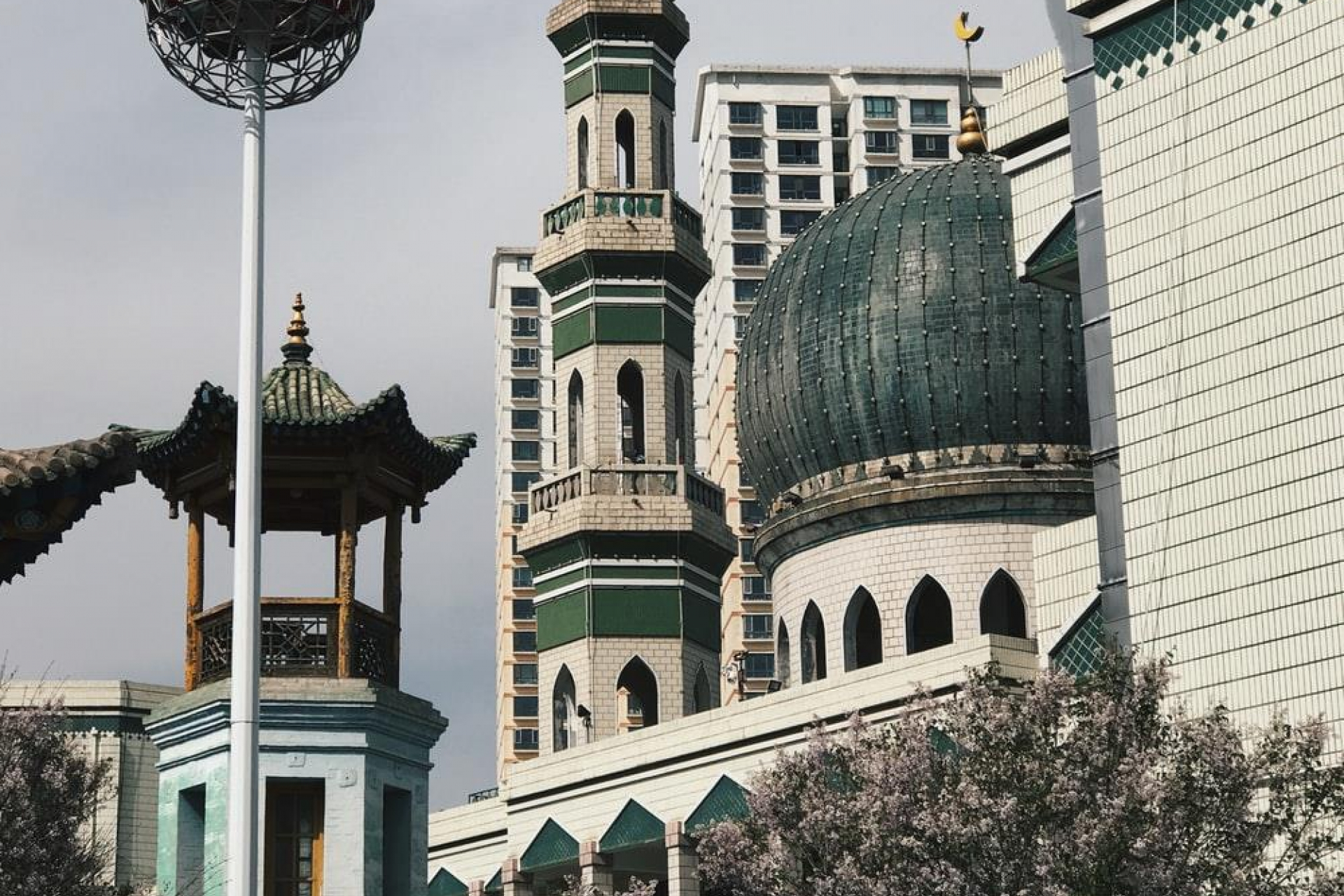
The Chinese government strictly controls the practice of Islam, and severely represses Islamic worship among members of the Uighur minority population in Xinjiang [see Section III(a)¡ªSpecial Focus for 2005: China's Minorities and Government Implementation of the Regional Ethnic Autonomy Law]. All public mosques throughout the country must register with the state-run China Islamic Association. The government bans all private mosques, as it does private religious venues of any faith. Before they can practice, imams must be licensed by the Chinese government, and afterward must attend patriotic education sessions regularly. The China Islamic Association's Islamic Affairs Steering Committee, established by the central government in March 2001, continues to author suggested sermons and to censor Islamic religious texts to ensure that all published interpretations properly reflect "socialist development and advanced culture."72

Several provinces are running Ethnic Unity and Advancement Campaigns demanding that religious organizations decrease their financial dependence on the state while also accepting fewer contributions from their practitioners.73 The government continues to subsidize religious personnel who "ardently love their country,"74 but several mosques have been forced to charge visitors admission fees or lease out portions of their facilities.75 To fund its growing debts last summer, the Religious Management Committee of the Guangyuan mosque in Sichuan province reportedly allowed private investors to convert two stories of the mosque into an "Arabian Nights Bar and Discotheque."76 The new RRA provisions that allow foreign and domestic donations to religious organizations may ease some financial pressures, but all of their revenue and expenditures must be reported to SARA.77

Outside of the Xinjiang Uighur Autonomous Region, the government allows some Muslim groups to run private schools for minors in poor areas and to engage in other social welfare programs.78 A government-run Web site highlighted in 2005 the achievements of a privately run Islamic school in Gansu province,79 for example, and the Qinghai press praised the Dongguan mosque's contributions of food and shelter to the needy.80 Outside of Xinjiang, the government allows some mosques81 registered with the China Islamic Association to manage religious schools for those 18 years and older.82 As the government notes the positive contributions of Islamic groups, officials may allow them to assume greater responsibility for the nation's growing social welfare needs.

Within Xinjiang, the Chinese government conflates private Uighur Islamic practices with "religious extremism" and "ethnic splittism."83 Islam is a key component of Uighur ethnic identity, and the government is concerned it may be used to build support for greater effective autonomy. Uighurs face more restrictions on their religious life than other Muslims, including non-Uighurs living in Xinjiang.84 According to a member of Xinjiang's Academy of Social Sciences, Xinjiang has more religious regulations than any other province, providing the government a "powerful legal weapon" to control religion.85 In a major policy statement in January, Xinjiang General Secretary Wang Lequan declared that the Party "must unremittingly make education in atheism part of the effort to transform social customs, guide the masses to develop a scientific, civilized, and healthy way of life, and promote nationality development and progress."86 Xinjiang leaders hail China's new RRA as a "prime opportunity" to increase religious management in the struggle against religious extremism and splittism.87

The current crackdown on Uighur Islamic practices began with the collapse of the Soviet Union in 1991 and has increased in intensity in the post-September 11 era.88 Central and provincial authorities developed a set of religious regulations in the early 1990s that impose restrictions in Xinjiang not found elsewhere in China.89 These restrictions continue to determine policy today. The Party Central Committee imposed "severe controls on the building of new mosques"90 in 1996, the same year that Xinjiang authorities targeted "religious extremists and ethnic separatists" for arrest91 during a national "strike hard" campaign against general crime.92 New regulations in October 1998 required all imams in Xinjiang to attend mandatory "patriotic education" courses each year to renew their accreditations.93 In 2001, the Xinjiang local people's congress amended the central government's 1994 Regulations on the Management of Religious Affairs restricting religious observances to those who "safeguard the unification of the motherland and national solidarity, and oppose national splittism and illegal religious activities."94

The government arrested more than 200 Muslims in July and August 2005 for possessing "illegal religious texts."95 The Xinjiang government prohibits state-sanctioned religious groups below the provincial level from publishing religious materials without receiving prior approval from the Xinjiang State Administration of Religious Affairs.96 Individuals and groups are strictly prohibited from publishing or disseminating any material with "religious content" without government permission.

Central government officials assured the foreign press in March 2005 that minors are allowed to worship freely in China,97 but the Xinjiang government prohibits children under 18 years of age from entering mosques or receiving religious instruction even in their own homes.98 Students may not observe religious holidays, fast during Ramadan, or wear religious clothing in public schools. The government requires teachers to report students who pray or observe Ramadan.99 The government regulates the construction of mosques and has closed hundreds of them since the mid-1990s.100 The government outlaws all private religious classes (madrassas) and mosques in Xinjiang.

Government controls on religious belief and practice in Xinjiang not only violate the freedom of religion of Xinjiang's minority people, but also their freedom of expression and the right of each minority to protect and develop its own culture that is conferred by the 1984 Regional Ethnic Autonomy Law.101 Government policies also contravene several international conventions to which China is a signatory.102 The government's refusal to recognize the Uighurs' constitutionally guaranteed right to practice their religion freely has exacerbated tensions in the region [see Section III(a)¡ªSpecial Focus for 2005: China's Minorities and Government Implementation of the Regional Ethnic Autonomy Law]. A recent Human Rights Watch report warns that unless the government eases controls on Uighur religious activities, the policy "will likely alienate Uighurs, drive religious expression further underground, and encourage the development of more radicalized and oppositional forms of religious identity."103

Religious Freedom for China's Orthodox Christians

Orthodox Christian life is slowly reawakening in China, although the community is small and has no priests to conduct divine liturgy.104 The central government has refused to grant Orthodoxy the same status as the five "official" religions, but local authorities have registered Orthodox communities in Ghulja, Harbin, Labdarin, and Urumqi.105 Many observers think that the absence of a provision in the new RRA restricting official recognition of religions to a list of five was meant to ease the path of Orthodoxy to recognized status.106 The government has held talks with representatives of the Russian Orthodox Church, which is urging Chinese officials to permit Chinese seminarians studying for the priesthood in Russia to exercise their ministry in China.107

Religious Freedom for China's Protestants

The new RRA has not improved religious freedom for Chinese Protestants, with those worshipping in unregistered house churches continuing to be targeted for official repression. The government has continued a campaign begun in 2002 focused on harassing and repressing unregistered Protestant groups and consolidating control of registered Protestants.108

Although the RRA applies equally to all religions, some of its provisions address issues of primary concern to Protestants. Article 6 appears to permit Protestant house churches to register with the Ministry of Civil Affairs without also registering with the SARA or the Three Self Patriotic Movement (TSPM), the official national Protestant organization. Some Western analysts believe that the new registration system was designed to address complaints by unregistered Protestant groups that local SARA offices ignore their applications. Whatever its purpose, the new system has resulted in a difference of opinion among house church leaders.109 Some house churches want the security of legal recognition and the opportunity to establish approved kindergartens and health clinics, as well as to run seminaries and exchanges with foreign countries. Other house church leaders fear that their churches will not be able to maintain independence from the TSPM if they register, or that the government will tighten repression against those churches that refuse to register.110

Government authorities committed human rights abuses against unregistered Protestants during the past year. Hundreds of unregistered Protestants associated with the house church movement have been intimidated, beaten, or detained. A US-based NGO that monitors the persecution of Chinese Protestants reported mass detentions of house church leaders and members in February, May, June, July and August of 2005. These detentions included American missionary workers and often involved the physical abuse of detainees.111 Cai Zhuohua, a house church pastor in Beijing, and several of his relatives were detained in September 2004 when the government discovered a large stock of religious literature in their possession. The government tried them in July 2005 for "illegal business practices," but the court has not yet issued a judgment.112 Zhang Rongliang, leader of the Fangcheng Fellowship of house churches and co-author of the 1999 "House Churches of China's Confession of Faith and Declaration," has been detained since December 2004.113 Tong Qimiao, a Christian businessman, was beaten by public security officials in Xinjiang and later visited by officials who threatened to ruin his business if he did not sign an affidavit stating that he had not been beaten.114 Several cases from previous years continued to develop. The United Nations Working Group on Arbitrary Detention (UNWGAD) took up the case of Zhang Yinan, a house church historian sentenced to re-education through labor, and in December 2004 the UNWGAD found that government deprivation of Zhang's liberty was arbitrary and contravened the Universal Declaration of Human Rights (UDHR).115 Gong Shengliang, pastor of the South China Church, continues to serve a life sentence; nine of the state's witnesses against Pastor Gong now say that their testimony was extracted from them under torture.116

Recent government directives on religion have responded to the growth of Protestantism by re-emphasizing longstanding policies that require subservience to the state. In August 2004, the government reiterated that Party members may not believe in any religion, prohibited religious activity at universities, and clarified what is not permitted when dealing with foreign religious organizations.117 A particularly insistent part of the campaign to make registered Protestants conform to state policies has been the TSPM's imposition of a "theological construction" that will, in the words of TSPM Chairman Ding Guangxun, "weaken those aspects within Christian faith that do not conform with the socialist society." 118 Such aspects include justification by faith, Christ as the sole path to salvation and the inerrancy of Scripture, which are fundamental beliefs of most Chinese Protestants. Some professors and students who have challenged this imposed theology have been removed from seminaries.119

The Chinese government opposes the relationships that many unregistered Protestant house churches have developed with co-religionists outside China. Many house churches are organized into networks that receive overseas support, especially from evangelical groups in the United States.120 Many detentions of house church worshipers follow contacts with foreigners, and the government frequently charges house church leaders with maintaining illicit connections abroad.121 House churches generally do not pursue these overseas connections for political reasons, but rather to obtain financial support and training. These relationships also help house church leaders publicize abuses against unregistered Christians.122 At the same time, the Chinese government permits the leadership of the TSPM to maintain extensive relations abroad with interdenominational "mainline" Protestant organizations. In May 2005, a TSPM delegation attended the World Council of Churches Conference on World Mission and Evangelism for the first time.123

Protestantism is becoming an important influence on Chinese society and culture. Estimates of the total number of Protestants in China range from 30 to 100 million.124 Despite their relatively small number compared to China's total population, Protestants are a growing presence in many eastern provinces and cities and at many universities. Most Protestants in these areas are young people, and the majority of them are women.125 Unregistered and registered Protestants generally respect the authority of the Chinese government and most house church leaders hope for evolutionary rather than revolutionary changes in China. Both unregistered and registered Chinese Protestants hope to play a role in shaping China's future.126

The Chinese government seeks to blunt many of the effects and influences of Protestantism, but it welcomes others. The Chinese government sees threats to social "harmony" and Party control over religion in certain ideas spreading in house church circles, particularly the reintroduction of Protestant denominational distinctions and Protestant evangelicalism and Pentecostalism.127 But the government welcomes the social service projects undertaken by the Amity Foundation, a well-established Protestant foundation that in the past has sponsored projects in rural development, leadership training, public health, AIDS clinics, care for the elderly, and orphanages.128 The Chinese government has also permitted several Protestant schools to open and supported the plans of a U.S.-based NGO to open China's first post-1945 privately-run university with an openly Christian mission.129 Some officials at the local level have recognized the stabilizing influence of religion on Chinese society.130

Notes to Section III(d)¡ªFreedom of Religion

1 Regulation on Religious Affairs [Zongjiao shiwu tiaoli] [hereinafter RRA], issued 7 July 04. The RRA is available on the Xinhua Web site. An English translation is available online on the Web site of China Elections and Governance, and in Kim-Kwong Chan and Eric R. Carlson, Religious Freedom in China (Hong Kong: Hong Kong Institute for Culture, Commerce, and Religion, 2005), 78¨C89.

2 For example, in one county in Anhui province, the local Religious Affairs Bureau interpreted its duty to manage religious affairs according to law as a mandate to "resolve hot issues, . . . boost the force of management according to law, [and] effectively protect political and social stability." "Managing Religious Affairs According to Law in Lingbi County" [Lingbixian yifa guanli zongjiao shiwu], Suzhou Municipal Government Web site, 14 June 05. The Bureau reported that it used a "heavy inspection" process to follow up on problems discovered in annual inspection forms submitted by religious venues. Then it "strictly carried out the law" to address those problems. First, it handled 30 cases in which the rights and interests of religious people and entities had been violated. Second, it worked with the county police to break up illegal activities, including 119 unauthorized meetings (most likely house church meetings). Of these, the Bureau caused 38 to merge with "legal" religious venues, and banned the other 81. It also seized 21 evangelical preachers, "educating and reforming" 16 of them, and putting the other five into administrative detention. It found 23 centers of "cult activity." Of the 38 people seized in these centers, the Bureau detained four for criminal prosecution, put 22 into administrative detention, and detained four for criminal prosecution.

3 Nailene Chou Wiest, "Religious Groups Get More Room to Move," South China Morning Post (Online), 20 October 04.(2283).

4 Ibid. (2283)

5 Wang Zuoan, "Establish the Idea of Managing Religious Affairs According to Law," Chinese Religions, 26 February 05 (FBIS, 26 February 05). For existing Chinese laws that can be used to hold officials accountable for their actions, see, e.g., PRC Administrative Litigation Law, enacted 4 April 89; PRC State Compensation Law, enacted 12 May 94; PRC Administrative Licensing Law, enacted 12 August 03; PRC Administrative Punishment Law, enacted 17 March 96; and PRC Law on Administrative Reconsideration, enacted 29 April 99. All of these laws except the Administrative Reconsideration Law can be found on the CECC Web site. The text of the Law on Administrative Reconsideration can be found on the Ministry of Finance Web site.

6 "Highlights: Report on Ethnic Stability Issues in PRC 31 Dec 2004¨C17 Mar 2005," Foreign Broadcast Information Service, 23 March 05 (FBIS, 23 March 05) (citing the Tibet Daily, 18 January 05). The threat of hostile infiltration into religious circles from outside China has long been a preoccupation of Chinese authorities, particularly in areas with large populations of ethnic minorities. The CCP Central Committee emphasized this danger in Document No. 6, a 1991 internal document setting out religious policy. Circular of the Central Committee of the Chinese Communist Party and the State Council Concerning Several Issues in Which Religious Work Has Not Been Successful [Zhonggong zhongyang, Guowuyuan, guanyu jin yi bu zuohao zongjiao gongzuo ruogan wenti de tongzhi], issued 5 February 91, available at Chinese Religious Materials Net (Online). An English translation appears in Chinese Law and Government, Vol. 33, No. 2, 56¨C63 (March/April 2000).

7 "Highlights: Report on Ethnic Stability Issues in PRC 31 Dec 2004¨C17 Mar 2005," Foreign Broadcast Information Service (citing the Tibet Daily, 18 January 05). Tibetan authorities also held some follow-up activities to publicize the contents of the RRA when the regulation became effective in early March. Ibid.

8 "Highlights: Report on Ethnic Stability Issues in PRC 31 Dec 2004¨C17 Mar 2005," Foreign Broadcast Information Service (citing the Yunnan Daily, 7 February 05, and the Xinghua Daily, 18 February 05).

9 Xiong Fei, "Henan Party School President Points out Importance of Religious Affairs," Henan Daily, 27 April 05 (FBIS, 12 May 05).

10 Ibid. In Jiangsu, Ren Yanshen, Deputy Party Secretary and Director of the Leading Group on Ethnic and Religious Work, focused even more sharply on the need to use the RRA to resist foreign infiltration under the guise of religion. Ren reiterated that Jiangsu faced a "new situation" of this kind of threat from outside. "Highlights: Report on Ethnic Stability Issues in PRC 31 Dec 2004¨C17 Mar 2005," Foreign Broadcast Information Service (citing Xinhua Daily, 18 February 05). This level of fear in Henan and Jiangsu, possibly related to local increases in the numbers of Protestant believers in the two provinces, raises the danger of official and police abuse of believers.

11 See, e.g., the Web sites of the Cardinal Kung Foundation, Agape Press, Compass Direct, and Voice of the Martyrs.

12 RRA, art. 3. Outside observers have pointed out that the vague nature of the category "normal religious activities" makes the RRA promise of protection meaningless for a believer hoping to get redress against official abuse. Nicolas Becquelin, "Reins Tight on Religious Affairs," The Standard (Online), 18 February 05. (7419) Ambiguous language in the regulations gives officials and police too much discretion in cracking down on religious believers, whom the Party has long portrayed as people of questionable loyalty.

13 RRA, chap. 5. For a discussion of the implications of the property provisions of Chapter 5for the Catholic Church, see Anthony Lam, "A Commentary on the Regulations on Religious Affairs" (as translated by Michael J. Sloboda), 25 Tripod, No. 136 (Spring, 2005). Chapter 7 of the 1995 Shanghai Municipal Regulation on Religious Affairs offered protection for the properties owned or legally used by religious organizations and venues similar to that provide by the RRA. Shanghai Municipal Regulation on Religious Affairs [Shanghai shi zongjiao shiwu tiaoli], issued 30 November 95, amended 21 April 05. The 1995 version of the Shanghai regulation is posted on the Web site of the United Front Work Department.

14 RRA, art. 17.

15 Human Rights Watch, "Asia: State Control of Religion," 1997, 17¨C38. Magda Hornemann of Forum 18 argues that the RRA ensures yet more intrusive government regulation of religion than provided for under preexisting law and predicts that believers will continue to peacefully resist unreasonable interference in their religious activities. Magda Hornemann, "How Believers Resist State Religious Policy," Forum 18 News Service (Online), 18 January 05, 5687.

16 China's New Regulation on Religious Affairs: A Paradigm Shift? Staff Roundtable of the Congressional-Executive Commission on China, 14 March 05, Testimony of Mickey Spiegel, Senior Researcher, Human Rights Watch, New York.

17 China's New Regulation on Religious Affairs: A Paradigm Shift? Testimony of Daniel H. Bays, Professor of History, Calvin College.

18 China's New Regulation on Religious Affairs: A Paradigm Shift? Testimony of Carol Lee Hamrin, Consultant and Research Professor, George Mason University, Fairfax, VA.

19 Bernardo Cervellera, "Not Much New in the New Regulations on Religion: Interview with Anthony Lam, an Expert on the Church in China at the Holy Spirit Study Centre," AsiaNews (Online), 1 March 05. (7680)

20 Xu Mei, "China's New Religious Law Promises Little Change," Christian News Service (Online), 17 January 05.

21 See, e.g., "Varying Views on the Regulation that Became Effective on the First of March" [Points de vue nuanc¨¦s sur le reglement entr¨¦ en vigueur le 1er Mars], Zenit (Online), 9 March 05.

22 Xu Mei, "Christians React to New Religious Regulations," Compass Direct (Online), 9 March 05; 8924. "PRC Expert Comments on China's First National Law on Religious Affairs," Wen Wei Po, 1 March 05 (FBIS, 1 March 05);10539. PRC Promotion of Privately Run Schools Law, enacted 28 December 02 (requiring a strict separation of religion and education in such privately run schools). Another issue is whether the absence of a requirement for prior approval by the local branch of the Patriotic Religious Association (PRA) or the local religious affairs bureau before registering a religious organization with the Ministry of Civil Affairs under Article 6 of the RRA is meaningful. According to Magda Hornemann of Forum 18, many religious organizations, particularly Protestant Christian ones, have claimed that the approval of the local branch of the national Patriotic Religious Association, while not specified in prior regulations, was required before even approaching the state religious affairs office for registration. Magda Hornemann, "Religious Freedom and the Legal System: Continuing Struggle," Forum 18 News Service (Online), 28 April 04. 5474.

23 Commission Staff Interview.

24 RRA, art. 34. Previous regulations, like the 1995 Shanghai Municipal Regulation on Religious Affairs, already permitted religious organizations and venues to undertake commercial activities for self-support, and also to run activities in the public interest. See, e.g., the Shanghai Municipal Regulation on Religious Affairs, art. 11. <http://www.zytzb.org.cn/> and as amended is available at <http://www.law-lib.com/law/l>. Article 34 of the RRA adds language providing for the management and use of the proceeds from such activities. Lauren Homer, "Organizing and Funding Non-Worship Activities of Religious Organizations," paper presented at Religion and the Rule of Law: Comparative Approaches to Regulating Religion and Belief, Conference of the Chinese Academy of Social Sciences and Institute of World Religions, Beijing, China, 18¨C19 October 04.

25 RRA, art. 6. The RRA incorporates the Ministry of Civil Affairs' Regulation on Registration and Management of Social Organizations to govern the registration of religious organizations in the same way as some older regulations on religion. See the 1995 version of the Shanghai Municipal Regulation on Religious Affairs, art. 10, <http://www.zytzb.org.cn/>. However, unlike the old Shanghai rule, the RRA does not specify that religious organizations must first get approval from the local religious Affairs Bureau, and so could lead to a less burdensome scheme of regulation. However, Article 7 of the 2005 amendments to the Shanghai Regulation, issued after the promulgation of the RRA, specifically requires organizations to get such approval before applying to the local civil affairs bureau. Lauren B. Homer, "The New Regulation of Religious Affairs in China: A Legal Analysis," paper delivered at Fuller Seminars Program, Fuller Seminary, 2 March 05, 15 (manuscript on file with the CECC).

26 "China to Ease Policies on Religion, NGOs," United Press International, reprinted in Washington Times (Online), 20 October 04. (2300)

27 Article 12 of the RRA merely says: "Collective religious activities of religious citizens shall generally be conducted on the premises of registered venues for religious activities (Buddhist temples, Taoist temples, mosques, churches, and other fixed places of religious activities)" (emphasis added).

28 Becquelin, "Reins Tight on Religious Affairs";(7419) Homer, "The New Regulation on Religious Affairs in China: A Legal Analysis," 2; "Chinese Underground Churches Face Legalization," Voice of Germany Chinese Service, reprinted on Boxun (Online), 20 May 05; "Varying View on the Regulation that Became Effective on the First of March," Zenit (8344).

29 Wiest, "Religious Groups Get More Room to Move";(2283). see generally, Unofficial Religion in China: Beyond the Party's Rules, Staff Roundtable of the Congressional Executive Commission on China, 23 May 05.

30 See "Religious Freedom for China's Orthodox Christians," infra this Section.

31 On May 23, 2005, the Commission held a roundtable to discuss the situation of unofficial religions in China entitled "Unofficial Religion in China: Beyond the Party's Rules." Professor Robert Weller drew on the recent experience of Taiwan to show how the state's efforts to control and repress popular religions failed to eradicate them and ultimately gave way, after political liberalization in the 1980s, to a rich combination of religious societies and beliefs. Temple-based activity, now legal, has fostered community solidarity and the growth of local civil society. Pietistic groups, no longer repressed, offer individuals a place to meet and discuss moral and religious issues based on a variety of spiritual texts. The end of religious control in Taiwan has allowed the growth of new humanitarian Buddhist societies, with millions of members worldwide, which have an explicit social mission of building hospitals, founding universities, bringing aid to the poor, and providing emergency relief. At this event, a witness confirmed that there had been rumors that SARA might soon add a category of "Popular Religion" to the authorized list of religions.

32 CECC, 2004 Annual Report, 5 October 04, 36¨C7. See also stories collected in "Highlights: China's Religious Affairs, Falungong, Anti-cult Documents," Foreign Broadcast Information Service, 27 September 04 (FBIS, 27 September 04.)

33 "Special Characteristics of Religion and Cults in Contemporary China," Popular Science News (Online), 25 May 05; "Entire City Finals Held in Speaking Competition on the Topic 'Respect Science; Fight Cults," Baoji Daily (Online), 2 June 05.

34 His defection was soon followed by that of Hao Fengjun, a "610" officer posted to Australia, who brought with him a computer disk containing hundreds of reports sent by agents in Australia to a "610" security office in China. According to a document inspected by Commission staff that was purported to be a copy of a 610 security office form, local officials have a number of specific "610" duties involving Falun Gong members. Officials have to fill out periodic reports on their performance of duties like forming "610 small groups" and entering 610 activities into the work schedule. Officials who fail to perform such tasks receive a fixed number of demerits on their annual work evaluation.

35 Unofficial Religion in China: Beyond the Party's Rules, Testimony of Patricia M. Thornton, Associate Professor of Political Science, Trinity College, Hartford, CT.

36 In comparison, the 1994 Regulation Governing Venues for Religious Activities [Zongjiao huodong changsuo guanli tiaoli], issued 31 January 94, and abrogated on the effective date of the RRA, did not explicitly refer to social and public interests: "No person shall be permitted to make use of any such venue to undertake activities which harm national unity, ethnic unity, or the social order, harm citizens' health or obstruct the national educational system."

37 RRA, art. 17: "Venues for religious activities shall set up management organizations and practice democratic management. Members of the management organizations of venues for religious activities shall be selected through democratic consultations and reported as a matter of record to the registration management organs for the venues." (In a Tibetan monastery or nunnery, a DMC is generally made up of monks or nuns elected from among themselves. Candidates are sometimes screened by local officials, according to some reports.)

38 Commission Staff Interviews.

39 "The Sixth Training Class for Temple Administrative Committee Directors in Tibet Concludes," China's Tibet, 31 May 05 (FBIS, 1 June 05).

40 Commission Staff Interviews.

41 Commission Staff Interviews.

42 The Gelug is the largest of several traditions of Tibetan Buddhism that are currently practiced. The Dalai Lama and Panchen Lama are the most revered spiritual teachers of the Gelug. Tibetan Buddhist followers of other traditions, such as the Kargyu, Sakya, Kadam, Jonang, and Nyingma, also revere the Dalai Lama. The Dalai Lama served as the head of the Lhasa-based Tibetan government until 1959, when he fled into exile along with most of the Tibetan government. The Chinese government continues to subject Gelug monasteries to heightened levels of suspicion and control because of the Dalai Lama's close association with the Tibetan government-in-exile.

43 Commission Staff Interviews.

44 Commission Staff Interviews.

45 Based on data available in the PPD in June 2005, there were 121 Tibetan political prisoners known or believed to be currently imprisoned. Sixty-seven were held in the TAR, 38 in Sichuan province, 13 in Qinghai province, and three in an unknown location. As of June 2005, of the 42 Tibetan political prisoners known to have been detained from 2002 onward, and known or believed to remain imprisoned, 27 were held in Sichuan province, eight in Qinghai province, and seven in the TAR.

46 Commission Staff Interviews. Official permission to travel to India is almost never granted, according to experts.

47 Liu Yuxiang and Wu Kun, "Analysis on Threats of Violent Acts of Terror Presently Facing Sichuan Province," Policing Studies, No. 2, 10 February 04 (FBIS, 17 May 04).

48 "The Execution of Lobsang Dondrub and the Case Against Tenzin Deleg: The Law, the Courts, and the Debate on Legality," Topic Paper of the Congressional-Executive Commission on China, February 2003. In December 2002, the Ganzi Intermediate People's Court sentenced Tenzin Deleg, a popular religious leader in Ganzi, TAP, to death with a two-year reprieve for endangering state security by writing separatist leaflets and causing explosions. No details about the evidence have ever been made public and NGOs allege that he was framed because of his popularity. Officials accused his co-defendant, Lobsang Dondrub, of setting off the explosions and scattering the leaflets, and Tenzin Deleg of being a conspirator. Lobsang Dondrub was sentenced to death in December 2002 and executed on January 26, 2003. Media and NGO reports allege that he was tortured into confessing.

49 The phrase, "dismissed after the reorganization of monasteries," refers mainly to monks who were expelled from monasteries, or fled them, during an intense campaign of Patriotic Education conducted throughout Tibetan areas from 1996¨C2000. Authorities traveled to every Tibetan monastery and nunnery and led mandatory classes on Party-sanctioned positions on religion, the Dalai Lama, and Tibetan history. Upon completion of the course, monks and nuns had to pass examinations and then sign or fingerprint a statement denouncing the Dalai Lama, accepting the legitimacy of the Panchen Lama enthroned by China, and endorsing China's account of Tibetan history. According to unofficial estimates, several thousand monks and nuns gave up their seats rather than accept the Party's demands.

50 Criminal Verdict of the Sichuan Province Ganzi Tibetan Minority Autonomous Prefecture Intermediate People's Court, 2000, Ganzi Intermediate Court Verdict No. 11, reprinted in Selection of Cases from the Criminal Law, The Dui Hua Foundation, August 2003, 42¨C55. The translation of the official sentencing document shows that the court agreed that Sonam Phuntsog had not explicitly called for "Tibetan independence," but nonetheless sentenced him for inciting splittism because he "incited the masses to believe in the Dalai Lama."

51 State Council Information Office, "White Paper on Freedom of Religious Belief in China, "Xinhua, 16 Oct 97 (FBIS, 16 Oct 97). "[T]he approval of the reincarnation of the Grand Living Buddhas by the central government is a religious ritual and historical convention of Tibetan Buddhism, and is the key to safeguarding the normal order of Tibetan Buddhism."

52 "President Hu Meets 11th Panchen Lama," Xinhua (Online), 3 February 05.

53 Commission Staff Interviews.

54 In the late 1950s, the Chinese government organized the Catholic Patriotic Association (CPA), gave it control of all Church property, and convinced a small group of bishops and priests to proclaim their independence from the Holy See and subordinate themselves to the CPA. Since that time, the government has worked to persuade and coerce Catholic clergy and laity to do the same. The majority have refused to do so and have gone "underground," where, persisting in their fidelity to the Holy See, they have refused to attend Masses offered by priests who accept the authority of the CPA. Today there are more than 8 million unregistered and 4 million registered Catholics in China. On the situation of the Catholic Church in China today, see, Betty Ann Maheu, MM, "The Catholic Church in China: Journey of Faith. An Update on the Catholic Church in China: 2005," paper delivered at the 21st National Catholic China Conference, 24 June 05, Seattle, WA, U.S. Catholic China Bureau (Online); Han Fengxia, "Growth of Christianity in China: Perspective of a Woman Religious of the Liaoning Diocese," address delivered at the 21st National Catholic China Conference in Seattle, WA, 26 June 05 (available at the Web site of the U.S. Catholic China Bureau).

55 Commission Staff Interview. Igor Rotar, "Xinjiang: Controls Tighten on Muslims and Catholics," Forum 18 News Service (Online) 29 September 05; Xing Guofang, "A New Wave of Persecution Against Hebei Catholics," AsiaNews (Online), 27 September 05.

56 Commission Staff Interviews. "Classes Begin at New Sichuan Seminary Campus Amid Concerns Over Standard of Teaching," Union of Catholic Asian News (Online), 30 September 05.

57 "Prisoners of Religious Conscience for the Underground Roman Catholic Church in China," Cardinal Kung Foundation (Online), 31 July 05.

58 Commission Staff Interviews. For the detentions reported in the past 12 months, see, "Underground Roman Catholic Bishop Arrested in China," Cardinal Kung Foundation (Online), 6 January 05; "Arrest of an Underground Roman Catholic Priest," Cardinal Kung Foundation (Online), 30 January 05; Arrest of an Underground Roman Catholic Bishop and a Priest; Reflection on the Pope's Passing From the Underground Roman Catholic Church," Cardinal Kung Foundation (Online), 3 April 05; "Arrest of Seven Underground Roman Catholic Priests in China," Cardinal Kung Foundation (Online), 27 April 05; "Police Disperse 'Underground' Catholic Retreat, Send Priests Home," Union of Catholic Asian News [hereinafter UCAN] (Online), 9 June 05 (undetermined number of priests detained for a short period); "Underground Roman Catholic Bishop Arrested Again in China," Cardinal Kung Foundation (Online), 4 July 05; "Underground Roman Catholic Priest and His Parishioners Beaten and Arrested in China," Cardinal Kung Foundation (Online), 28 July 05. Bishop Jia Zhiguo was detained in September (twice) and December of 2004, and in January and July of 2005. "Bishop Julius Jia Zhiguo Arrested," AsiaNews (Online), 5 July 05. For the release of Catholic prisoners of religious conscience, see "Release of an Underground Roman Catholic Priest," Cardinal Kung Foundation (Online), 5 June 05 (release of Zhao Kexun after two months of detention); "Chine: Lib¨¦ration d'un pr¨ºtre clandestin emprison¨¦ en 1999. Une nouvelle salu¨¦e par Radio Vatican," Zenit (Online), 4 July 05 (release of Kong Guocun after nearly six years of detention); "Bishop Julius Jia Zhiguo Released in Hebei," AsiaNews (Online), 22 July 05. Regarding a letter sent by unregistered Catholics to a Catholic news agency abroad to protest a "wave of violence" unleashed in Gao Cheng county, Hebei province, see, Wang Hui, "Persecution in Hebei, a Liability for Hu Jintao's Plans," AsiaNews (Online), 8 June 05; Magda Hornemann, "Is Central or Local Government Responsible for Religious Freedom Violations? " Forum 18 News Service (Online), 2 August 05; "Underground Roman Catholic Priest and a Recently Graduated Seminarian Arrested in China," Cardinal Kung Foundation (Online), 4 September 05. Regarding a foreign Web site blocked in China after it published an article critical of China's human rights record vis-¨¤-vis Catholics, see, Sandro Magister, "Riconoscimenti. In Cina, www.chiesa entra nel club degli oscurati," L'espresso (Online), 25 July 05.

59 Commission Staff Interview; "Underground Bishop of Roman Catholic Church in China 'Lost' for More Than 6 Years Found Very Ill in Government Detention," Cardinal Kung Foundation (Online), 19 November 03.

60 Commission Staff Interviews; "China to Defy Rome With New Bishops? " Catholic World News (Online), 14 March 05; "China: State Attempts to Control Religious Leaderships," Forum 18 News Service (Online), 15 June 05.

61 "Vatican Confirms Informal Dealings With China," Catholic World News (Online), 30 June 05.

62 Regarding the ordination of Xing Wenzhi in Shanghai, see "New Shanghai Bishop: 'Serving the Community Against the Spread of Secularization,' " AsiaNews (Online), 29 June 05; "Choice of Bishop Positive Step Toward Vatican Ties," South China Morning Post, 30 June 05 (FBIS, 30 June 05) (Bishop Xing announced during a ceremony that he had been nominated by the Holy See); "Further On China Says Vatican Did Not Approve Appointment of Shanghai Bishop," Agence France-Presse, 29 June 05 (FBIS, 29 June 05) (denial issued by Shanghai Religious Affairs Bureau); "Vatican Confirms Informal Dealings with China," Catholic World News (Online), 30 June 05; "Ordination of a Patriotic Association Bishop in Shanghai," Online Newsletter, Cardinal Kung Foundation (Online), 1 July 05 (points out that the Holy See has not issued an official statement); Gianni Valente, "Anche a Shanghai c'¨¨ qualcosa di nuovo," Trenta Giorni (Online), 1 August 05. Regarding the ordination of Dang Mingyan in Xi'an, see "The Vatican Recognizes New Appointment in the Xi'an Diocese," Wen Wei Po, 29 July 05 (FBIS, 30 July 05) (CPA official claims that bishop was appointed in accordance with procedures of "Chinese Catholic Church," that the Vatican had recognized a bishop "elected in China," which is "an improvement and is favorable to moving Sino-Vatican relations forward"); "China und Heiliger Stuhl einigen sich erneut auf Bischof," Kath.net (Online), 1 August 05.

63 "Shanghai Bishop Seeks to Heal Division," Washington Post (Online), 23 June 05 (registered Bishop Jin: "Rome said that after the death of the underground church bishop, no more division."); "China: The Government and the Holy See Ordain a Bishop Jointly for the First Time," AsiaNews (Online), 28 June 05.

64 Betty Ann Maheu, MM, "The Catholic Church in China: Journey of Faith. An Update on the Catholic Church in China: 2005"; Sandro Magister, "Nuovi vescovi per la Cina di domani," L'espresso (Online), 16 August 05; Sandro Magister, "La Cina ha un nuovo record: i pi¨´ giovani vescovi del mondo," Settimo Cielo (Online), 17 August 05.

65 Commission Staff Interviews; "Vocation-rich Zhouzhi Diocese Faces Uncertainty After Bishop Dies," UCAN (Online), 28 September 04; "Mgr Paul Su Yongda, New Bishop of Zhanjiang," AsiaNews (Online), 15 November 04; "Bishop of Datong Dies at 87, Leaving Management of Diocese to Young Priests," UCAN (Online), 12 January 05; Wang Xixian "Octogenarian Bishop Dies in Eastern China, Leaves Anhui Province 'Vacant,' " UCAN (Online), 18 March 05; "Bishop of Tianjin Dies Without Reconciling With 'Underground' Prelates," UCAN(Online), 18 March 05; "Bishop Giuseppe Zhu Huayu the Only Bishop in Anhui Province Dies at the Age of 88," Agenzia Fides (Online), 19 April 05; "Body of Chinese Catholic Leader Cremated," Xinhua (Online), 28 April 05 (FBIS, 28 April 05); "China: The Government and Holy See Ordain a Bishop Jointly for the First Time," AsiaNews; "Franciscan Doctor-Bishop of Yichang Dies at Age 88," AsiaNews/ UCAN (Online), 26 July 05; "Open Church Bishop of Mindong Dies, Underground Bishop Seriously Ill," UCAN (Online), 11 August 05; "Death of Two Bishops: Bishop Thomas Zhao Fengwu, A Life of Poverty and Penance, and Bishop James Xie Shiguang, Who Spent 30 Years in Prison," Agenzia Fides (Online), 30 August 05.

66 Commission Staff Interviews.

67 Adam Minter, "The Sisters of Shanghai: A Congregation of Nuns Flourishes in China, "Commonweal (Online), 12 August 05; "Xi'an Seminary Offers Educational Program for Women Religious," UCAN (Online), 23 September 04; "Shaanxi Sisters Pursue Studies in Social Work, "UCAN (Online), 2 November 04; "More Than 'Half the Sky,' " Hong Kong Sunday Examiner (Online), 17 July 05; Betty Ann Maheu, MM, "The Catholic Church in China: Journey of Faith. An Update on the Catholic Church in China: 2005"; "Seminary College's First Symposium With Mainland Scholars Inspires Priests," Union of Catholic Asian News (Online), 26 August 05;"Chine: les religieuses am¨¦liorent leur formation," Zenit (Online), 7 October 04; "Precious Contribution Offered by the Prado Institute for the Formation of Priests and Religious in China Underlined During a Recent Visit by Superior General Rev. Robert Daviaud," Agenzia Fides (Online), 12 July 05; "Formation, Evangelization, Self-Support, Pastoral Care to Meet Needs of Today: Commitments of Bishop Anthony Li Du An of the Diocese of Xi'an," Agenzia Fides (Online), 27 July 05; Bernardo Cervellera, "Chinese Priest: We Need Help to Form Priests in the Official Church," AsiaNews (Online), 8 August 05. For a rare report on the formation of clergy for the unregistered Catholic community in China, see "Meeting With Underground Religious in Rome," Online Newsletter, Cardinal Kung Foundation (Online), 1 July 05.

68 "Nuns Serving Mentally Challenged Children Help Change Social Attitudes," UCAN (Online), 2 September 04; "Liaoning Diocese Goes Full Throttle With Its New HIV/AIDS Ministry," UCAN (Online), 9 September 04; "Nuns Care for Mentally Challenged Children in Xi'an, "UCAN/AsiaNews (Online), 11 February 05; "Interreligious Conference Affirms Religions' Contribution To Ethics, Morality," UCAN (Online), 9 March 05.

69 Commission Staff Interview.

70 "Guidelines on China from the Vatican," Cardinal Kung Foundation (Online).

71 "Breakthrough in Vatican-China Ties? " Reuters (Online), 19 August 05 (senior European Catholic prelate speculates on coming "breakthrough" in diplomatic relations); Ram¨®n Pedrosa, "Beijing and the Vatican Edge Closer," International Herald Tribune (Online), 18 August 05; Sandro Magister, "Nuovi vescovi per la Cina di domani"; "Pope Benedict Reaches Out to China," Associated Press (Online), 12 May 05; John L. Allen, "The Word From Rome," National Catholic Reporter (Online), 13 May 05; Lucia Pozzi, " 'Pechino dice s¨¬ al dialogo con il Papa'; Intervista a Dong Jinyi, ambasciatore cinese a Roma. 'Cos;igrave; cambia il mio Paese,' " Il Messaggero (Online), 14 May 05; "Pope Reaches Out to Non-Catholics and China During First Month," Associated Press (Online), 18 May 05; Elisabeth Rosenthal, "Hints of Thaw Between China and Vatican," International Herald Tribune (Online), 22 May 05; Joe McDonald, "Beijing, Vatican Express Enthusiasm for Ties, But Church's Role Remains a Stumbling Block," Associated Press (Online), 29 May 05; "Hong Kong Bishop: Vatican 'Anxious' for Diplomatic Ties with Beijing," Catholic World News (Online), 14 June 05; Nailene Chou Wiest, "Beijing Paving Way to Renew Vatican Links," South China Morning Post (Online), 15 June 05 (FBIS, 15 June 05); "Vatican Expresses Desire for Ties With China, but Stresses Religious Freedom," Associated Press (Online), 17 June 05; "Religious Freedom the Key, Says Vatican as It Seeks Ties," South China Morning Post (Online), 18 June 05; "Vatican Official Optimistic About Relations With China, Archbishop Lajolo Upbeat After Asian Trip," Zenit (Online), 23 June 05; "Bishop Calls for China, Vatican Compromise," Associated Press (Online), 23 June 05 (referring to Bishop Jin); "China and Vatican Make No Secret of Thaw," Los Angeles Times (Online), 25 June 05; "Report: Chinese Catholic Official Says Vatican and China Will Establish Ties," Associated Press (Online), 27 June 05 (referring to Anthony Liu Bainian); Minnie Chan, "Vatican Ties Closer With New Bishop," South China Morning Post, 30 June 05 (FBIS, 30 June 05) (referring to bishop Xing and reporting that the Chinese government sets up an intergovernmental working group on religious affairs to discuss potential relations with the Holy See); Wei Wu, "China's Religious Official on Prerequisite to Better China-Vatican Ties," Xinhua (Online), 1 July 05 (referring to spokeswoman for SARA); Gerard O'Connell, "China Reportedly Wants 'to Change its Relations' With the Holy See," UCAN (Online), 22 July 05; Vatican Information Service Press Release, 25 July 05; Bernardo Cervellera, "Chinese Priests Visit the Pope: an 'Unexpected Gift'; a Sign of 'Union With the Holy See,' " AsiaNews (Online), 4 August 05; Wu Yung-chiang, "The Pope Meets With Chinese Priests; Foreign Ministry Makes No Comment on This," Ta Kung Pao, 4 August 05 (FBIS, 5 August 05); "Chinese Youths Visit the Pope Before Heading for World Youth Day," AsiaNews (Online), 10 August 05; "Catholics Regret Over Vatican Decision," China Daily (Online), 12 September 05; "China Rebuffs New Vatican Call to Send Bishops," South China Morning Post (Online), 13 September 05; "Negotiations Still on for Chinese Bishops' Rome Visit," AsiaNews (Online), 16 September 05; Gerard O'Connell, "Four Mainland China Prelates Absent as Pope Opens Synod of Bishops," Union of Catholic Asian News (Online), 3 October 05; Bernardo Cervellera, "Beijing's No to Bishops Shatters Illusion That Things Have Changed for the Better," AsiaNews (Online), 1 October 05. On the fundamental factors influencing Sino-Holy See relations in recent years, see, Beatrice Leung, "Sino-Vatican Relations at the Century's Turn," Journal of Contemporary China, Vol. 14, No. 43 (May 2005), 353¨C370.

72 "Committee to Spread True Koran," China Daily (Online), 24 April 02; "PRC: Qinghai Enhances Religious Work to Guard Against Separatist Infiltration," Qinghai Daily, 8 September 04 (FBIS, 11 January 05).

73 Provinces have launched separate campaigns at various times since 2000. For discussion of Qinghai's campaign, launched in April 2004, see "PRC: Qinghai Enhances Religious Work to Guard Against Separatist Infiltration," Qinghai Daily.

74 Ma Pinyan, "The Implementation of the Party's Religious Policy in Xinjiang" [Dang de zongjiao zhengce zai xinjiang de shixian], Xinjiang Social Sciences, No. 1, 2005, 49¨C55.

75 "PRC: Qinghai Enhances Religious Work to Guard Against Separatist Infiltration," Qinghai Daily.

76 "Sichuan Guangyuan Sacred Mosque Becomes A Bar!" Bulletin Board Post, Crescent Review (Online), 21 June 04. A mosque in Gansu province opened a slaughterhouse to "ease the burden on its believers." "Linxia Hui Autonomous Prefecture's Ethnic Unity and Advancement Campaign Activities," Gansu Daily, 15 June 05 (Online).

77 RRA, arts. 35 and 36.

78 Hui girls in Shujinwan village in northern Yunnan, for example, take Chinese, Arabic, and religious classes in a school run by a local ahong. Elisabeth Alles, "Muslim Religious Education in China," 45 Perspectives Chinoises (January¨CFebruary 2003) (Online).

79 "Top Ten Islamic News Stories of 2003" [2003 zhongguo yisilin shida xinwen], Islamic Crescent Web site, 15 January 05. Nankai University, located in the coastal city of Tianjin, sent "patriotic education" volunteers to the school less than a year after its establishment. "Nankai University Students Set Up A Base in Gansu" [Nankai zai Gansu shili daxuesheng shixian jidi], Current Trends (Online), 7 September 04.

80 "PRC: Qinghai Enhances Religious Work to Guard Against Separatist Infiltration," Qinghai Daily.

81 Though estimates vary widely, there are an estimated 40,000 mosques in China. Elisabeth Alles, "Muslim Religious Education in China."

82 Ibid.

83 Human Rights Watch, "China: Human Rights Concerns in Xinjiang," October 2001. An article in the Party's main theoretical journal warned the leadership not to "underestimate the threat to society that splittism and illegal religious activities pose." The author of the article proposed attacking the "root of the problem" by refusing to "loosen controls over religion." He Ruixia, "Political Thought Work In the Course of Strengthening and Improving the Struggle Against Nationality Splittism" [Jiaqiang he gaijin fandui minzu fenliezhuyi douzhengzhong de sixiang zhengshi gongzuo], Seeking Truth, No. 2, 2004, 23. A 2002 report by the Hetian Party Committee found that "religion, illegal religious activities and extremist religious thought have severely influenced, disturbed and infiltrated society and villages." "Separatists Alleged to Have Infiltrated Xinjiang Schools," Agence France-Presse, 31 January 02 (FBIS, 31 January 02).

84 Practicing Islam in Today's China: Differing Realities for the Uighurs and the Hui, Staff Roundtable of the Congressional-Executive Commission on China, 17 May 04, Testimony of Kahar Barat, Lecturer in Near Eastern Languages and Civilizations, Yale University; Human Rights Watch, Devastating Blows: Religious Repression of Uighurs in Xinjiang, April 2005.

85 Ma Pinyan, "The Implementation of the Party's Religious Policy in Xinjiang" [Dang de zongjiao zhengce zai xinjiang de shixian], Xinjiang Social Sciences, No. 1, 2005, 52.

86 Wang Lequan, "Maintain the Dominant Position of Marxism in Ideological Work and Adhere to the Four Cardinal Principals," Seeking Truth, No. 2, 2005.

87 He Ruixia, "Political Thought Work In the Course of Strengthening and Improving the Struggle Against Nationality Splittism"; Ma Pinyan, "The Implementation of the Party's Religious Policy in Xinjiang."

88 Human Rights Watch, Devastating Blows: Religious Repression of Uighurs in Xinjiang, 14¨C 20; Gardner Bovingdon, Autonomy in Xinjiang: Han Nationalist Imperatives and Uyghur Discontent (Washington: East-West Center Washington, 2004).

89 Human Rights Watch, Devastating Blows: Religious Repression of Uighurs in Xinjiang, 31.

90 "Record of the Meeting of the Standing Committee of the Political Bureau of the Chinese Communist Party Concerning the Maintenance of Stability in Xinjiang (Document 7)," reproduced in Human Rights Watch, China: State Control of Religion, Update #1 (Online), 13 March 98.

91 The Chinese government carefully guards the precise number of arrests made during the campaign, but one Uighur ¨¦migr¨¦ group with detailed records on the arrests reports that 2,200 were arrested in the single prefecture of Khotan from April to July alone. World Uighur Network News, 16 July 96, in Michael Dillon, Xinjiang¡ªChina's Muslim Far Northwest (London: Routledge, 2004), 86. Xinjiang's chair of the United National Revolutionary Front reportedly claimed that 10,000 were arrested in Aksu and 8,000 in Urumqi, though the Chinese government later denied those figures. Urumqi radio announced on July 8th that 400 had been arrested and 3,700 families had been required to sign written pledges not to participate in any further anti-party activities. Michael Dillon, Xinjiang¡ªChina's Muslim Far Northwest, 87¨C88.

92 The restrictions on religious practice led to widespread resentment among the Uighurs that culminated in protests at Yining (Ghulja) in February 1997. Although reports differ on exactly what sparked the clash between Uighurs and Chinese security forces, eyewitnesses and official reports confirm that People's Armed Police shot a number of unarmed demonstrators and security forces arrested hundreds of Uighurs for their participation in the protests demanding religious freedom and rights enshrined in the 1984 Regional Ethnic Autonomy Law. Human Rights Watch, Devastating Blows: Religious Repression of Uighurs in Xinjiang, 15; Michael Dillon, Xinjiang¡ªChina's Muslim Far Northwest, 92¨C99; Amnesty International, "People's Republic of China: China's Anti-terrorism Legislation and Repression in the Xinjiang Uighur Autonomous Region," 2002.

93 These courses entail study of state-approved religious interpretations, review of "the correct relationship between religion and socialist society," and sessions in which imams publicly criticize their own political views as well as those of fellow imams.

94 Draft Amendments to the Xinjiang Uighur Autonomous Region Regulations on the Management of Religious Affairs Adopted by the 23rd Session of the Standing Committee of the 9th People's Congress of Xinjiang Uighur Autonomous Region [Xinjiang weiwuer zizhiqu dongjiao shiwu guanli tiaoli xiugai zheng an (caoan)], submitted 16 July 01, art. 9.

95 "China Bans Islamic Group in Xinjiang, Arrests 179," Agence France-Presse, 19 August 05 (FBIS, 19 August 05); "Teacher and 37 Students Detained for Reading Koran in China," Agence France-Presse, 15 August 05 (FBIS 16 August 05).

96 Human Rights Watch, Devastating Blows: Religious Repression of Uighurs in Xinjiang, April 2005, 46, note 91.

97 "Ministry of Foreign Affairs Spokesman Liu Jianchao Answers Reporters Questions," Ministry of Foreign Affairs Web site, 3 March 05.

98 Xinjiang Implementation Measures on the Law on the Protection of Minors [Xinjinagweiwuer zizhiqu shishi 'wei chengnianren baohu fa' banfa], issued 25 September 93; Ma Pinyan, "The Implementation of the Party's Religious Policy in Xinjiang" [Dang de zongjiao zhengce zaixinjiang de shixian], Xinjiang Social Sciences, No. 1, 2005, 53.

99 "China Cracks Down on Its Muslims," Agence France-Presse, 23 November 01 (FBIS, 23 November 01).

100 The 2000 Urumqi Yearbook [Wulumuqi nianjian] (Urumqi: Xinjiang People's Press, 2001),250¨C1. This volume notes that Yili prefectural officials had closed 70 "illegal constructions or renovations of religious sites" between 1995 and 1999 in their prefecture alone.

101 A specific requirement that any publication "related to the research and appraisal of Islamic religion" be submitted to national-level authorities before publication also contravenes the 1984 Regional Ethnic Autonomy Law. This requirement is listed in a 2000 "Manual for Municipality Ethnic Religious Work" edited by the Ethnic Religious Work Committee of the Urumqi Nationality Religious Affairs Bureau Work Committee. Cited in Human Rights Watch, Devastating Blows: Religious Repression of Uighurs in Xinjiang, 48.

102 Including the Universal Declaration of Human Rights, International Covenant for Civil and Political Rights, The Convention on the Rights of the Child, and The Convention Against Discrimination in Education.

103 Human Rights Watch, Devastating Blows: Religious Repression of Uighurs in Xinjiang, 8.

104 The Russian Orthodox Church claims that there are about 12 to 15 thousand Chinese Orthodox, most of them Chinese citizens of Russian or mixed-Russian descent. Most of them are located in northern China, Beijing, or Shanghai. Though there has never been an autocephalous Chinese Orthodox Church, in the 1950s an autonomous Chinese Orthodox Church was formed under the Moscow Patriarchate. Both of its Chinese bishops died during the Cultural Revolution. "Keeping the Faith," South China Morning Post (Online), 28 March 05; "About Orthodoxy in China: Interview with Archpriest Nikolai Balashov," RIA Novosti (Online), 13 October 04; "Toward a Rebirth of the Orthodox Church in China. Interview with Mitrophan Chin," Religioscope (Online), 23 October 04.

105 Commission Staff Interview; Li Fangchao, "Harbin Talks of Rebuilding Church," China Daily (Online), 5 September 05; "Orthodox Church Asks China for Official Recognition to Enhance Activities," UCAN (Online), 24 June 04; "Tiny Chinese Orthodox Church Seeks Recognition," Telegraph (Online), 3 January 04; "Beijing Is Sending Positive Signals to Orthodox Church," Taipei Times (Online), 21 October 04; Igor Rotar, "Xinjiang: No Children in Church, Catholics Told," Forum 18 News Service (Online); Igor Rotar, "Xinjiang: Linked Religious Practice and State Control Levels? " Forum 18 News Service (Online). Though local authorities have registered Orthodox communities in some areas, in others they have refused. In December 2003, Chinese officials briefly detained a Russian Orthodox priest from Kazakhstan who was providing pastoral care to Orthodox Christian believers in Yining (Ghulja), Xinjiang. Igor Rotar, "Security Service Investigation Followed Orthodox Priest's Deportation," Forum 18 News Service (Online).

106 Commission Staff Interview; "Something New But Mostly the Same Old Rules on Religion," AsiaNews (Online), 12 January 05; "Priest Dionisy Pozdnyaev Comments on the 'Regulation on Religious Affairs' Adopted in the PRC," Orthodoxy in China (Online), 24 December 04.

107 Commission Staff Interview; "Beijing's Orthodox Community Has First Paschal Liturgy Since 1957," Orthodoxy in China (Online), 3 May 05; "Eye on Eurasia: Russia's Church in China," United Press International (Online), 27 October 04; Geraldine Fagan, "Will Orthodox Christians Soon Be Allowed Priests? " Forum 18 News Service (Online), 22 September 04; "Shanghai News Spokesperson Explains Closure of Dining Hall Managed by Taiwan Businessman," Orthodoxy in China (Online), 13 January 05; "A Verbatim Record of Vladimir Putin's Meeting With Participants in the Bishops' Council of the Russian Orthodox Church," Orthodoxy in China (Online), 8 October 04; "Report of the Chairman of the Department of External Church Relations of the Moscow Patriarchate, Metropolitan Kirill of Smolensk, to the Bishops' Council of the Russian Orthodox Church (October 3¨C8, 2004), on External Church Activity, Care of the Diaspora of the Russian Orthodox Church," Orthodoxy in China (Online), 4 October 04; "China Visit of Russian Orthodox Church Delegation Comes to an End," Orthodoxy in China (Online), 26 October 04; "Entertainment Institutions to Be Ejected From Former Orthodox Churches in Shanghai," Orthodoxy in China (Online), 20 July 04; "China's Ambassador Gave Dinner Honoring Chairman of Department of External Church Relations Moscow Patriarchate," Orthodoxy in China (Online), 13 July 04; Igor Rotar, "Xinjiang: Controls Tighten on Muslims and Catholics," Forum 18 News Service (Online), 29 September 05; ("One Orthodox source told Forum 18 that four Chinese citizens have now completed training at Orthodox seminaries in Russia and are ready for ordination, but so far the Chinese authorities had not given them permission to work in China as priests.")

108 Sandro Magister, "Lo strano ritiro spirituale di Jiang Zemin e compagni," L'espresso (Online), 14 January 04.

109 Bernardo Cervellera, "New Regulations for Controlling Religions," AsiaNews (Online), 20 December 04; Lauren B. Homer, "The New Regulation on Religious Affairs in China: A Legal Analysis," 12.

110 Commission Staff Interview.

111 Commission Staff Interview; "Five American Church Leaders Arrested in Henan; Female House Church Evangelists Tortured and Abused in Xinjiang and Hubei; Secret Documents Show Chinese Government's Campaign Against Religious Cults," China Aid Association (Online), 17 August 05; "American Tourists Mistreated; Arrested House Church Pastors Tortured in Prison; Shanghai House Church Faces Forced Closure," China Aid Association (Online), 8 August 05; "Wave of Arrests Submerges Hope in New Regulations," Compass Direct (Online), 20 July 05 (reporting several detentions of small groups that went unreported elsewhere); "Nationwide Crackdown on House Churches in China; Numerous Leaders Arrested; Renown Beijing Church Leader Trial Delayed Again," China Aid Association (Online), 29 June 05; "Massive, Coordinated Crackdown on House Church Christians in China's Jilin Province," China Aid Association (Online), 9 June 05; "American Church Leaders Deported; Beijing House Church Pastor Tortured in Prison," China Aid Association (Online), 2 March 05. Regarding the mass arrests of recent months, see "One Hundred House Churches Raided in China," Voice of the Martyrs Canada (Online), 15 June 05 (Voice of the Martyrs has "received a copy of an official Chinese government document outlining a new offensive on underground house churches"). Most analysts believe that rural Christians are more persecuted than their urban counterparts. Allie Martin and Jenni Parker, "Rural Chinese Christians Suffer Behind State's Religious Freedom Façade," Agape Press (Online), 10 June 05.

112 "Prominent Beijing House Church Leader Faces Harsh Sentence," China Aid Association (Online), 11 November 04; Jason Lee Steorts, "With the Chinese Christians," National Review (Online), 31 January 05; "American Church Leaders Deported; Beijing House Church Pastor Tortured in Prison," China Aid Association; "Nationwide Crackdown on House Churches in China; Numerous Leaders Arrested; Renowned Beijing Church Leader Trial Delayed Again," China Aid Association (Online); "Beijing Church Leader Put on Trial; Relatives and US Embassy Official Blocked," China Aid Association (Online), 7 July 05; "Chinese Pastor Put on Trial," Voice of the Martyrs (Online), 7 July 05; Wang Te-chun, "Pastor Prosecuted for Illegally Publishing and Distributing the Bible," Ta Kung Pao, 8 July 05 (FBIS, 8 July 05); Hans Peterson, "China: Why Can't All Christian Bookshops Sell Bibles? " Forum 18 News Service (Online), 24 August 05.

113 "Senior Chinese House Church Leader Arrested; More Churches Raided Before Christmas," China Aid Association (Online), 10 December 05; "China: Christian Church Leader Arrested and at Risk of Torture For Possession of Religious DVDs," Amnesty International UK (Online), 23 December 04; "House-Church Leader Arrested; Zhang Rongliang Has a High Profile in China and Internationally," Christianity Today (Online), 5 January 05. On Zhang and the Fangcheng Fellowship and the Confession of Faith, see also David Aikman, Jesus in Beijing: How Christianity Is Transforming China and Changing the Global Balance of Power (Washington, D.C.: Regnery, 2003), 74¨C80, 92¨C95. In addition, approximately ten foreign Protestant leaders were expelled and 130 Chinese Protestant lay leaders were briefly detained when security officials raided a house church leadership training session in Harbin in February 2005. "American Church Leaders Deported; Beijing House Church Pastor Tortured in Prison," China Aid Association. Members of the South China Church claim that over 300 members of their church were detained between May and November 2004. "The Hard Truth Concerning the Case of the South China Church," Chinese Law and Religion Monitor, April¨CJune 2005, 118¨C128.

114 "Christian Businessman in Xinjiang Tortured and Hospitalized," China Aid Association (Online), 30 September 05; "Hospitalized Christian Businessman Threatened by State Security Agents," China Aid Association (Online), 3 October 05. For the worsening situation of all believers in Xinjiang, including Protestants, see Rotar, "Xinjiang: Controls Tighten on Muslims and Catholics."

115 "Mr. Zhang Yinan's Case and the UN Verdict," Chinese Law and Religion Monitor, April¨C June 2005, 79¨C117; "Chinese Church Historian Released from Labor Camp," China Aid Association (Online), 27 September 05 (officials released Zhang on September 25, 2005, at the end of his two year term).

116 For the witnesses who now say their testimony was extracted under torture, see "Chinese House Church Leaders First Time Testify at UN, Video Testimony From Tortured Women Believers Released," China Aid Association (Online), 2 April 2004; "Released South China Church Prisoners Re-arrested by Chinese Police," Voice of the Martyrs (Online), 14 October 2002 (report that Xiang Fengping and Li Yingping were sexually molested and tortured to extract testimony against Gong Shengliang); Roundtable on Religious Freedom, Staff Roundtable of the Congressional-Executive Commission on China, 25 March 02, Letter from Yulan (Jin Tongyen) and Testimony of Cui Guilian; Press Release, Committee for Investigation on Persecution of Religion in China, available at Free Church for China Web site, 29 January 02 (written testimonies of Zhang Hongjuan and Li Tongjin).

117 "A Member of the Communist Party Absolutely Cannot Believe in Any Religion" [Gongchan dangyuan jue bu neng xinyang renhe zongjiao], Bureau of Religious Affairs of Yunnan Province (Online), 15 August 04; "Reflections on the Condition of Religion Faith Among University Students in the Province," Gansu Ribao, 14 November 04 (FBIS, 16 November 04); "Secret Communist Party Document Orders New Initiative Promoting Atheism," China Aid Association (Online), 17 November 04 (contains text of the Notice on Further Strengthening Marxist Atheism Research, Propaganda, and Education).

118 Ding Guangxun [K.H. Ting], "A Call for Adjustment of Religious Ideas," Chinese People's Political Consultative News, 4 September 98, reprinted in Li Xihyuan, Theological Construction¡ªor Destruction, An Analysis of the Theology of Bishop K.H. Ting (Ding Guangxun) (Streamwood, Illinois: Christian Life Press, 2003), 109¨C111. For further evidence of the pressure to make Protestant theology conform to state ideology, see K.H. Ting, "Some Thoughts on the Subject of Theological Reconstruction," Chinese Theological Review, Vol. 17 (2003); K.H. Ting, "Adjustments in Theology are Necessary and Unavoidable," Chinese Theological Review, Vol. 17 (2003); Zhang Xiaofa, "The Popularization of Theological Reconstruction," Chinese Theological Review, Vol. 18 (2004); Li Weizhen, "On Justification by Faith," Chinese Theological Review, Vol. 18 (2004); Wang Guanghui, "De-Emphasis on Justification by Faith: An Instance of Theological Adaptation," Chinese Theological Review, Vol. 18 (2004). For a critical discussion of theological construction, see Li Xinyuan, "Theological Construction¡ªor Destruction? " The TSPM has also announced that it plans to consecrate bishops in the future, though the implementation of this plan has not yet been worked out, so that it remains to be seen what effect this will have on the religious freedom of registered Protestants who do not believe in episcopal authority. "Church Leadership Discusses Consecrating Bishops," Amity News Service (Online), 1 January 05; Wang Aiming, "Growth of Christianity in China: A Protestant Perspective of Ecumenical Challenges and Opportunities," address delivered at the 21st National Catholic China Conference in Seattle, WA, 26 June 05 (available at the Web site of the U.S. Catholic China Bureau).

119 Magda Hornemann, " 'Religious Distortion' and 'Religious Freedom,' " Forum 18 News Service, 25 November 04.

120 Aikman, Jesus in Beijing, 263¨C284; God and Caesar in China: Policy Implications of Church-State Tensions, eds. Jason Kindopp and Carol Lee Hamrin (Washington, D.C.: Brookings Institution, 2004), 137¨C139.

121 See, e.g., the press releases of the China Aid Association.

122 Aikman, Jesus in Beijing; Kindopp, Hamrin, God and Caesar in China.

123 "Chinese Churches Face Challenges of Growth," Ekklesia (Online), 11 May 05.

124 Paul Hattaway, Brother Yun, Peter Xu Yongze, and Enoch Wang, Back to Jerusalem: Three Chinese House Church Leaders Share Their Vision to Complete the Great Commission (Carlisle, UK: Piquant, 2003), 13 (80¨C100 million); Aikman, Jesus in Beijing, 9 (up to 80 million); Kindopp, Hamrin, God and Caesar in China, 2 (at least 30 million, "with estimated figures as high as 45 million to 60 million"); Gianni Criveller, "Pechino nuova Antiochia? " Mondo e Missione (Online), July¨CAugust 2005 (less than 30 million); "Millions All Over China Convert to Christianity," Telegraph (Online), 3 August 05; "Just How Many Christians and Communists Are There in China? " Ecumenical News International (Online), 14 September 05; Caroline Fielder, "The Growth of the Protestant Church in China," address delivered at the 21st National Catholic China Conference in Seattle, WA, 27 June 05 (available at the Web site of the U.S. Catholic China Bureau).

125 Aikman, Jesus in Beijing, 97¨C114. On Protestantism at Chinese universities, see Jen Linliu, "At Chinese Universities, Whispers of Jesus," Chronicle of Higher Education (Online), 10 June 05.

126 Commission Staff Interviews; Richard R. Cook, "Behind China's Closed Doors Newly Confident House Churches Open Themselves Up to the World," Christianity Today (Online), February 2005.

127 There are early signs of an emerging denominational sectarianism developing over disagreements as to Pentecostal and charismatic practices and the growing theological sophistication of the unregistered house churches, probably due to their increasing contact with Protestants outside China. Commission Staff Interview; "Threat of Denominationalism Requires Vigilance," Amity News Service (Online), August 2004. The government's concern with Protestant evangelicalism can be seen in many of the articles published in the Chinese Theological Review or on the Web site of the Amity News Service. On evangelicalism in China, see Aikman, Jesus in Beijing. For important criticisms of Aikman, particularly regarding the Pentecostal character of many of the Protestant house churches, see Samuel Pearson, "Jesus in Beijing: A Review Essay," Encounter LXV (Autumn 04), 393¨C402, and Gianni Criveller, "Pechino nuova Antiochia? " Mondo e Missione (Online), July¨CAugust 2005.

128 "Bringing the Church Into Society," Amity Newsletter (Online), March 2005, no. 7.

129 Commission Staff Interview. See also the Web site of St. Paul University of China.

130 Magda Hornemann, "Is Central or Local Government Responsible for Religious Freedom Violations?"


   Back to Top   Back To Top

  Previous Page  Previous Page
  Site Map   |  Contact Us  

The page was last modified on December 7, 2005
© 2002-2005 Congressional-Executive Commission on China - All Rights Reserved.