China Monitor #3
A publication to keep Members of Congress and the public informed about critical human rights and legal developments in China
February 26, 2026
Contents:
- Party Watch: High-Ranking Military Officials Removed for Apparently Political Reasons
- Journalists Detained amid Widening Suppression of Investigative Reporting
- Trial of Activists Illustrates Reach of PRC Transnational Repression in Kazakhstan
- Hong Kong National Security Prosecutions Highlight Security-Focused Governance
- Exporting Politically Aligned AI Models Advances CCP “Discourse Power” Globally
- Human Trafficking: PRC Uses Crackdown on Scam Centers for Self-Promotion
- Highlighted Political Prisoner Case—Ilham Tohti (ئىلھام توختى་)
Party Watch: High-Ranking Military Officials Removed for Apparently Political Reasons
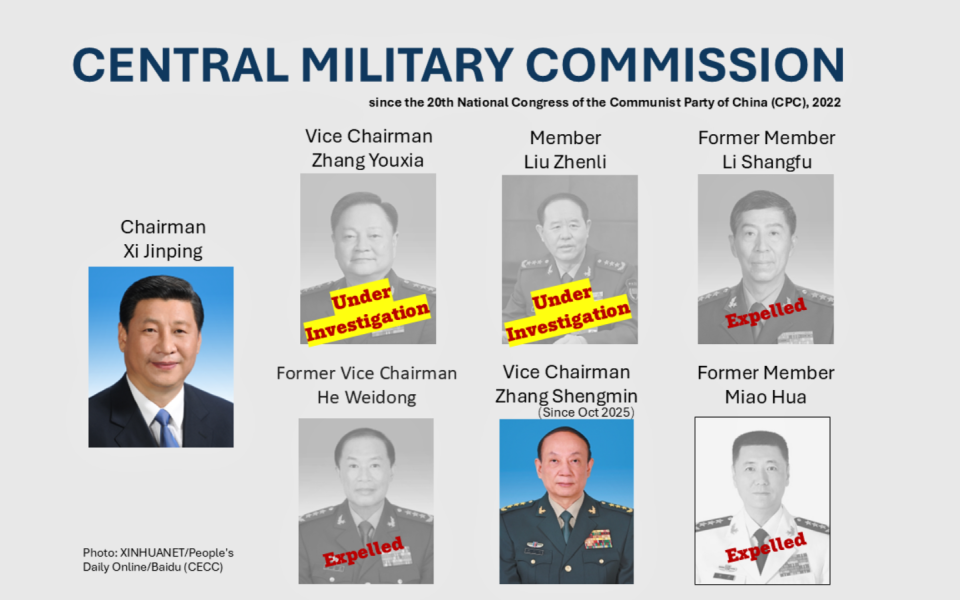
On January 24, 2026, the Ministry of National Defense announced the Party Central Committee’s decision to place two senior military officials under investigation for “suspected serious discipline and law violations.” The officials in question were Zhang Youxia and Liu Zhenli. Before their removal, Zhang was a Politburo member and vice chairman of the Central Military Commission (CMC), and Liu was a member of the CMC and chief of staff of the CMC Joint Staff Department. As of 2022, the CMC was chaired by Xi Jinping and comprised two vice chairs and four members. All but one of Xi Jinping’s subordinates have since been removed:
- Vice chair Zhang Youxia (张又侠)—investigation began in January 2026.
- Vice chair He Weidong (何卫东)—expelled from the Party in October 2025.
- Member Li Shangfu (李尚福)—investigation began in August 2023; expelled from the Party in June 2024.
- Member Liu Zhenli (刘振立)—investigation began in January 2026.
- Member Miao Hua (苗华)— expelled from the Party in October 2025.
- Member Zhang Shengmin (张升民)—still in office; promoted to vice chair in October 2025.
The Party telegraphed Zhang and Liu’s guilt the very day it announced the investigation. A People’s Liberation Army Daily article declared that the two had committed “serious political misconduct,” accusing them of weakening the Party’s absolute control over the military. Notably, the piece framed “corruption” in political terms—without citing concrete financial wrongdoing or other non-political misconduct.
That framing fits a broader pattern: in the Party’s “anti-corruption” messaging, loyalty and political discipline are often treated as the core offense, with corruption serving as the label. High-profile cases such as Sun Lijun (孙立军) and Sun Zhengcai (孙政才) were likewise presented less as investigations into graft than as prosecutions grounded in political disloyalty.
The custodial status of Zhang and Liu remains unknown and, as in similar cases, there is a lack of transparency about the legal provisions applicable to these cases. Many officials are detained under a form of extrajudicial detention known as “retention in custody” (留置, liuzhi), which authorities used to hold 38,000 people in 2024 alone. Deaths during liuzhi, as well as suicides shortly after liuzhi, have been reported. In one example, family members observed signs of torture on the deceased person’s body, including a disfigured face and a caved-in chest.
Journalists Detained amid Widening Suppression of Investigative Reporting
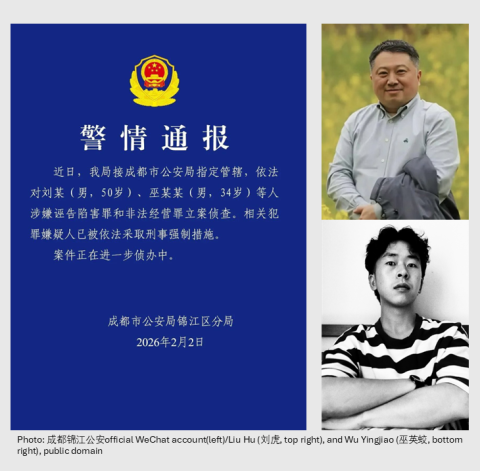
Chengdu authorities detained self-media journalists Liu Hu (刘虎) and Wu Yingjiao (巫英蛟) on February 1, 2026—days after they published a corruption exposé implicating a county Party secretary. Liu was held on suspicion of “making false accusations” (Criminal Law art. 243) and “illegal business activity” (CL art. 225). Online discussion was swiftly censored. China Digital Times has archived over 20 online articles discussing the case that were removed. Both were released on bail on February 16.
These detentions take place against a backdrop of an ever-decreasing space in which reporters can engage in investigative journalism in China. Investigative reporting has long served a watchdog function in China, allowing media some degree of influence in holding local government and Party officials accountable. However, in recent years, authorities have expanded control over this type of reporting. In July 2024, state media outlet Beijing News reporter Han Futao (韩福涛) published a report revealing that tankers, without being properly cleaned, were routinely used to transport both fuel and food products. In a recent interview by U.S.-based platform Tian Jian, another Beijing News reporter claimed that the tanker story caused the higher-ups to be “really unhappy,” noting, “[N]ow when we receive complaints [from citizens about public interest issues], even with evidence, we don’t write about them.”
This trend is not isolated to one news organization. In November 2025, journalist Li Wei’ao (李微傲) reported that, of the 43 news reports he had written in the past year, 10 had been censored, mostly involving investigation into topics such as official and state-owned enterprise corruption. In November 2025, Tencent deleted an investigative report video from the official account of state-owned newspaper the Paper analyzing e-commerce live-streamers making false claims. Subsequently, an article by the Paper arguing against this deletion was censored by Tencent, as well. An article by WeChat account Print Media Night Watchman (纸媒守夜人) notes that “there are now only 36 domestic news-media organizations that still conduct investigative reporting.”
Investigative reporting is being replaced by official notices from government bodies, called “blue background” statements because of their typical color. Such notices give government bodies complete control over the presentation of information, which in turn, as a former Global Times editor-in-chief claimed, “undermine[s] society’s long-term resilience and capacity to withstand pressure.”
Trial of Activists Illustrates Reach of PRC Transnational Repression in Kazakhstan
A closed trial in Kazakhstan of 19 Atajurt volunteers and supporters—people linked to an organization documenting the detention of ethnic Kazakhs in China—highlights how PRC pressure can spill across borders and shape repression in Kazakhstan. The defendants were detained on November 13, 2025, after joining a protest in the village of Qalzhat demanding the release of Alimnur Turganbay, a truck driver and citizen of Kazakhstan detained by PRC authorities in July 2025 after crossing the China-Kazakhstan border. Protesters burned PRC flags and a portrait of PRC leader Xi Jinping. Kazakhstan authorities initially charged the protesters with administrative offenses—punishing participants with fines and short-term detention— but later escalated their case to criminal prosecution.
That escalation appears to have followed a November 14 diplomatic note from the PRC consulate in Almaty, Kazakhstan, which reportedly called the protest an “open provocation” and urged a “serious investigation.” Radio Free Europe/Radio Liberty reported that the indictment against the defendants claims that their protest had “negatively impacted” bilateral “friendship.” A lawyer for 18 of the defendants argued that there was no basis for criminal prosecution and that the protest activities were protected under Kazakhstan law.
All 19 defendants—Kazakh citizens—have been charged under Article 174 of Kazakhstan’s Criminal Code, which carries a penalty of up to 10 years in prison for “inciting ethnic or national discord.” A court in the city of Taldykorgan began hearing the case on January 23, 2026.
Reports indicated that authorities may have detained Alimnur Turganbay for several possible reasons, including possessing “dual nationality,” despite his having formally renounced his PRC citizenship; his religious activities in the Xinjiang Uyghur Autonomous Region (XUAR); or his advocacy for a nephew who is imprisoned in the XUAR.
After authorities began placing Uyghurs, Kazakhs, and other Turkic Muslims in mass internment camps in the XUAR beginning around 2017, Kazakhstan-based family members of detainees publicized their cases, often in cooperation with the Almaty-based Atajurt. Kazakhstan, which has seen record levels of PRC investment in recent years, has applied pressure on Atajurt, including through detaining and fining Atajurt volunteers and by refusing to register the organization. Kazakhstan previously prosecuted the organization’s founder, Serikzhan Bilash, under Article 174, detaining him for five months in 2019 before he fled to the United States.
Hong Kong National Security Prosecutions Highlight Security-Focused Governance
A national security trial of three prominent Hong Kong pro-democracy figures opened on January 22, 2026, before High Court judges Alex Lee Wan-tang, Johnny Chan Jong-herng, and Anna Lai Yuen-kee. The defendants—Chow Hang-tung (鄒幸彤), Lee Cheuk-yan (李卓人), and Albert Ho Chun-yan (何俊仁)—are charged with “inciting subversion” under the 2020 National Security Law (NSL) for their involvement in the now-disbanded Hong Kong Alliance in Support of Patriotic Democratic Movements of China (Alliance). The Alliance organized annual vigils commemorating the 1989 Tiananmen crackdown and called for ending the CCP’s one-party rule. Amnesty International reported in 2025 that 84.6% of 78 concluded NSL cases involved “only legitimate expression that should not have been criminalised, with no evidence of violence or incitement.”
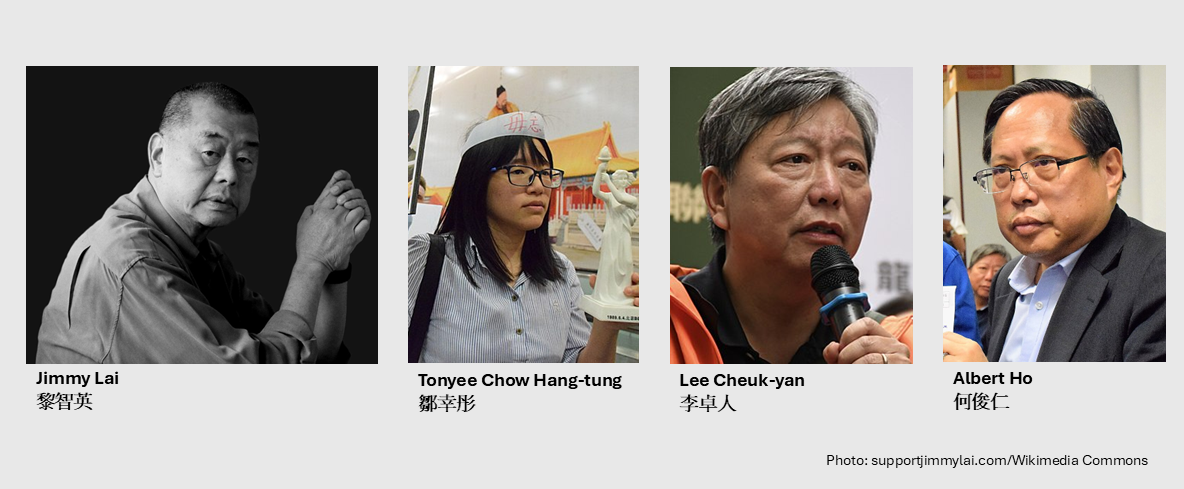
Authorities have also used the NSL to punish independent media. On February 9, 2026, a High Court sentenced Jimmy Lai Chee-ying (黎智英) to 20 years for conspiracy to collude with foreign forces and conspiracy to publish seditious materials—the harshest NSL sentence to date. Prosecutors argued that Lai used the now-shuttered Apple Daily to urge foreign governments to impose sanctions and take other actions hostile to the Hong Kong and PRC governments. Although the court noted Lai’s age (78) and poor health, it declined to substantially reduce the term, citing the seriousness of the offenses.
The eight co-defendants, including six former Apple Daily personnel, were sentenced as follows:
- Fung Wai-kong (馮偉光, also known as Lo Fung, 盧峯)—10 years.
- Lam Man-chung (林文宗)—10 years.
- Law Wai-kwong (羅偉光)—10 years.
- Andy Li Yu-hin (李宇軒)—7 years and 3 months.
- Yeung Ching-kee (楊清奇)—7 years and 3 months.
- Chan Pui-man (陳沛敏)—7 years.
- Cheung Kim-hung (張劍虹)—6 years and 9 months.
- Chan Tsz-wah (陳梓華)—6 years and 3 months.
Just one day after Lai’s sentencing, the PRC State Council issued a white paper claiming that the CCP has faithfully implemented the “one country, two systems” model, in large part by maintaining national security. Citing Lai’s case, the white paper also asserts that Hong Kong courts have preserved common law principles and procedural safeguards, despite widespread international criticism of the verdict.
Current and former chairs of the Commission, as well as other members of Congress, have introduced legislation prompted by the dismantling of the “one country, two systems” model in Hong Kong and the erosion of rights guaranteed by international law and treaty including the following bills: the Hong Kong Economic and Trade Office (HKETO) Certification Act (S. 3655/H.R. 2661, 119th Cong.) and the Hong Kong Judicial Sanctions Act (S. 1755, 119th Cong.). Specifically, the Hong Kong Judicial Sanctions Act requires the U.S. Government to assess whether certain Hong Kong and PRC officials, including judges and prosecutors, should be sanctioned for having violated human rights or undermining Hong Kong’s high degree of autonomy.
Exporting Politically Aligned AI Models Advances CCP “Discourse Power” Globally
A January 2026 Microsoft report found that DeepSeek is spreading fast worldwide—this growth is concentrated most heavily in countries rated “Not Free” by Freedom House, but also gaining traction in democracies like Spain and Canada. This is largely because DeepSeek is free and open source, making it easy to adopt. The risk of exporting Chinese Communist Party (CCP) censorship and propaganda grows when DeepSeek becomes the default chatbot on consumer phones, particularly Huawei devices, because defaults drive mass adoption and most users never switch. When a model with embedded political constraints is shipped as the out‑of‑box assistant, censorship and propaganda can scale from individual queries to an entire user base—quietly, persistently, and with a global reach.
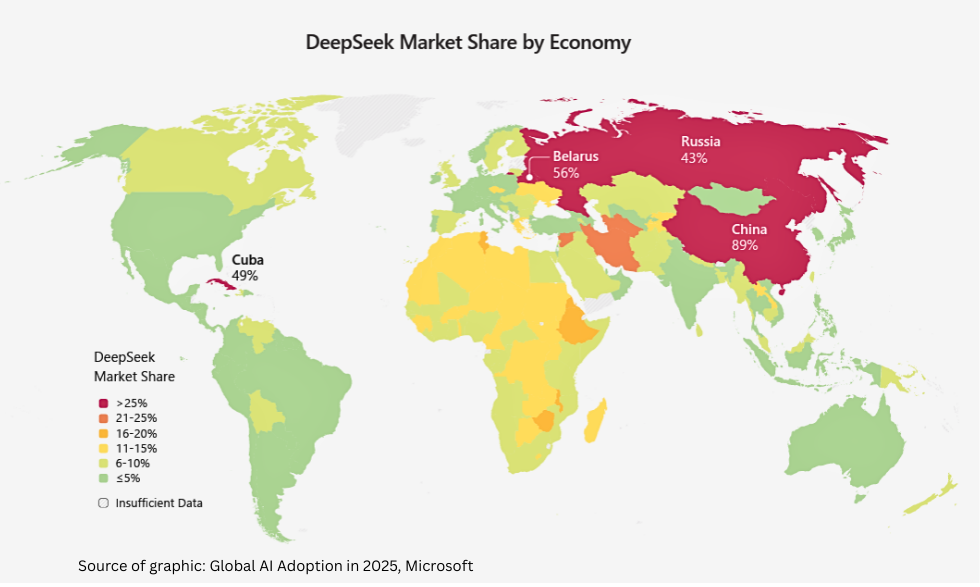
The practical effect is to expand the CCP’s “discourse power” (话语权)—the capacity for the CCP to shape global public opinion—an explicit strategic goal General Secretary Xi Jinping has said should be commensurate with China’s comprehensive national strength. When free default AI assistants mediate everyday search, writing, and translation, they become a scalable instrument of global influence—able to steer which economic and political priorities rise to the top and how the public understands them. That influence doesn’t require mass propaganda. It can work through countless small decisions about what to censor, soften, or emphasize—quietly engineering blind spots that, over time, shape and distort global opinion about the policies and practices of the CCP.
These concerns are not limited to DeepSeek. Given China’s 2023 AI rules requiring alignment with state political values and protection of China’s image, similar risks extend to other China-based models (Ernie, Qwen, Yuanbao, Kimi K2 Thinking) that testing shows can reflect CCP biases. Even if the rules technically apply only inside China, the biases built into the models are difficult to remove—and China-based developers have little financial incentive to create different versions for overseas deployment once the core model has been trained and fine-tuned to reflect political constraints.
Finally, the flexibility that makes these models easy to adopt creates a second risk: countries can tailor Chinese-built AI architectures to local values while still inheriting CCP-aligned rhetoric and framing. Examples include:
- Malaysia: NurAI, a DeepSeek-based AI model launched in August 2025 by Zetrix AI Bhd, is designed to be compatible with Islamic values yet has been shown to retain CCP biases (for example, characterizing human rights issues in the Xinjiang Uyghur Autonomous Region in line with official CCP narratives).
- Uganda: Sunflower, launched in October 2025 using Alibaba’s Qwen system, has produced answers ranging from balanced to clearly CCP-aligned (including describing China as a democracy).
Human Trafficking: PRC Uses Crackdown on Scam Centers for Self-Promotion
The Cambodian government’s ongoing crackdown on scam centers caused voluntary and trafficked workers to flee, including those hailing from the PRC, potentially putting them in further danger. In January 2026, Amnesty International estimated that thousands of people had either escaped or were released from 17 scam compounds that month. Prior to the recent crackdown, there were over 250 scam centers in Cambodia alone. Amnesty International’s Regional Research Director Montse Ferrer stated that “the mass release and escape attempts from scamming compounds of individuals who are possibly victims of human trafficking and torture raises concerns that thousands of people are now stranded in Cambodia without support and at risk of being re‑trafficked into other compounds.” Cambodian police detained 1,792 PRC citizens at a scam center in Bavet, Cambodia in February 2026.
The exodus of workers from the scam centers was preceded by the detention and subsequent extradition to China of Chen Zhi, chairman of the Prince Group, who is alleged to have run a “major cross-border gambling and fraud syndicate.” In January 2026, Xinhua said that the PRC Ministry of Public Security worked with Cambodian authorities to detain Chen on suspicion of “operating gambling dens, fraud, illegal business activity, and concealing and disguising criminal proceeds.” The PRC used Chen’s detention to promote its image as a responsible stakeholder in international law enforcement, hailing the operation as a “significant achievement in China-Cambodia law enforcement cooperation.” Chen’s detention and extradition to China came only a few months after the United States indicted him in October 2025 and sanctioned “146 targets within the Prince Group Transnational Criminal Organization.” PRC authorities were likely concerned over Chen’s prominence in Cambodia and his links with PRC state-affiliated firms and criminal activity in the region, which the PRC considers its “backyard.”
Not long after Chen’s detention and extradition, the PRC executed some of the ringleaders of scam operations in Southeast Asia, likely in part to further deter criminal activity in the region, but also to signal to the PRC domestic audience that it is responding to years-long criticism that the government was turning a blind eye to the issue. People’s Daily, a Chinese Communist Party media outlet, reported in January 2026 that the PRC executed 11 people from the Ming family criminal group for “crimes including intentional homicide, intentional injury, illegal detention, fraud, and operating gambling dens.” In February 2026, Xinhua said that four members of the Bai family criminal group had been executed following sentencing in November 2025 for crimes including “intentional homicide, intentional injury, fraud, drug trafficking and manufacturing, kidnapping, and operating gambling dens.” Following the executions, PRC Ministry of Foreign Affairs spokesperson Guo Jiakun stated that the PRC will “step up efforts [to combat] telecom fraud and online gambling and other related cross-border crimes.”
Highlighted Political Prisoner Case—Ilham Tohti (ئىلھام توختى་)
CECC Political Prisoner Database record number 2009-00315
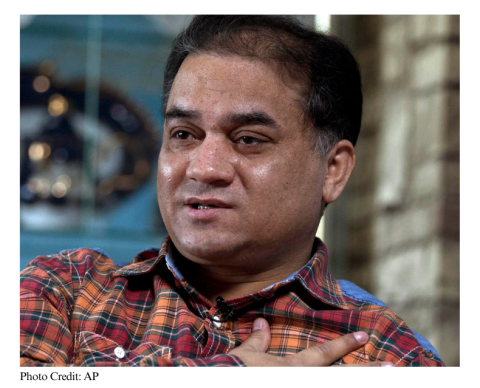
February 20, 2026 marked the twelfth anniversary of the formal arrest of Uyghur scholar Ilham Tohti, who, prior to his arrest and subsequent imprisonment, taught economics at Minzu University in Beijing municipality. In September 2014, a court in Urumqi municipality, Xinjiang Uyghur Autonomous Region (XUAR), sentenced him to life in prison on the charge of “separatism” (CL, art. 103), following a trial marred by legal violations and procedural errors. During his pretrial detention and imprisonment, authorities have reportedly subjected Ilham Tohti to torture and abuse, including by shackling his feet, depriving him of food, and placing him in solitary confinement. Authorities have also not allowed him to have visits from family members since 2017.
Demonstrating continued sensitivity regarding Ilham Tohti’s imprisonment, in February 2024, authorities reportedly detained Uyghur prison guard Ghopur Abdureshit for “intentionally spreading sensitive and negative information” after he revealed to other prisoners that Ilham Tohti had been placed in solitary confinement, was in poor health, and had limited access to sunlight. According to a September 2024 Radio Free Asia report, a court in the XUAR sentenced Ghopur Abdureshit to seven years in prison for sharing this information on Ilham Tohti’s condition in XUAR No. 1 Prison in Urumqi.
Through his teachings and writings, Ilham Tohti had, prior to his imprisonment, advocated for the rights guaranteed to Uyghurs by PRC law, and called attention to economic and unemployment inequality. Through the website he founded, Uyghur Online, he sought to increase understanding between Uyghurs and Han Chinese.
Ilham Tohti is one of a number of leading XUAR-based Turkic intellectuals and cultural figures whom authorities continue to detain. Rights groups documented the detention of Uyghur, Kazakh, and Kyrgyz scholars, musicians, writers, and journalists in mass internment camps and other facilities beginning around 2017. The Uyghur Human Rights Project referred to the detention of Uyghur and other cultural elites as “evidence of intent to destroy Uyghur cultural identity by crippling intellectual and cultural production.” Other cases illustrative of this trend include that of former Xinjiang University president Tashpolat Teyip, who was detained in 2017 and sentenced to death with a two-year reprieve, and that of Tursunjan Hezim, a Uyghur historian sentenced to life in prison in 2022.