China Monitor #5
A publication to keep Members of Congress and the public informed about critical human rights and legal developments in China
May 28, 2026
Contents:
- Forced Labor in China’s Seafood Supply Chain
- Two Men Convicted of Spying for China in HKETO Case
- Bookstore Arrests in Hong Kong
- PRC Influence Evident in Ruling on Protest Case in Kazakhstan
- Rising Mass Protests Reflect Chinese Resilience Under Censorship
- China’s Ecological and Environmental Law Enters a New Era, Raising Concerns About Public Interest Litigation
- AI Enhances PRC Propaganda
- Political Prisoner Case—Gao Zhen (高兟)
Forced Labor in China’s Seafood Supply Chain
Hearing on China’s IUU Fishing: At an April 16 hearing, the Commission continued its investigation into forced labor in the Chinese seafood industry. The hearing focused on illegal, unreported, and unregulated fishing and the economic and security impact of China’s aggressive global fishing fleets. Commissioners examined how those fleets disadvantage U.S. producers, distort seafood supply chains, undermine the maritime rights of other nations, and move goods made with forced labor into U.S. and global markets, in violation of U.S. law.
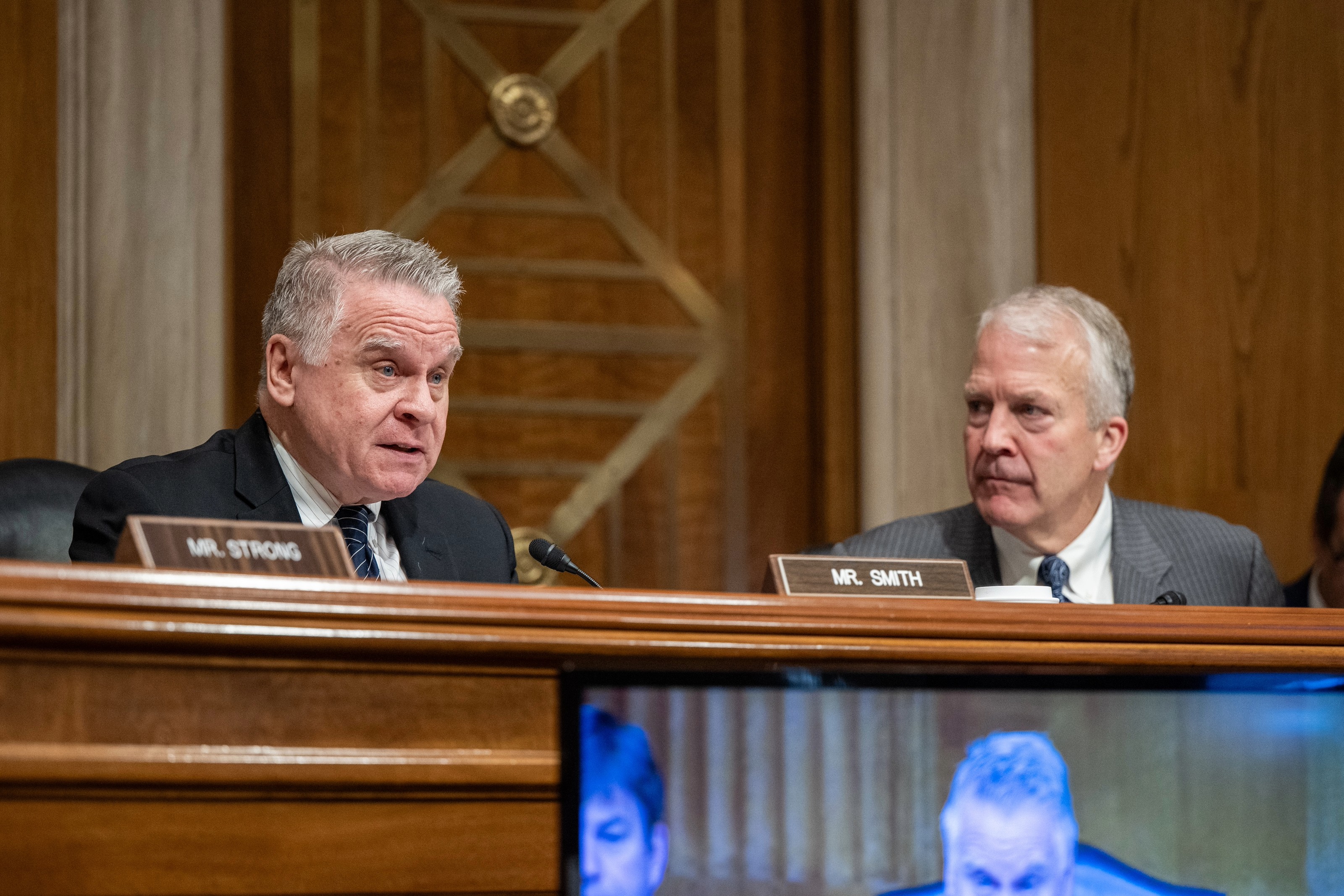
Witnesses included Ian Urbina, Director and Founder of The Outlaw Ocean Project; Rear Admiral Scott Clendenin, USCG (Ret.); and Hon. Dean Pinkert, Special Advisor at Corporate Accountability Lab. Their testimony described China’s seafood sector as a human rights, economic, and national security threat, calling attention to Uyghur, North Korean, and other migrant labor in Chinese seafood supply chains. Underscoring this, Commissioners heard video testimony from Muhammad Sahrudin, an Indonesian fisherman and labor trafficking survivor, who described beatings, unsafe conditions, and prolonged exploitation aboard a Chinese fishing vessel.
Urbina detailed the expansion of China’s aquaculture industry in the Xinjiang Uyghur Autonomous Region and Tibet. He warned that seafood products from this sector continue to reach U.S. markets. Clendenin characterized China’s distant-water fishing fleet as a geopolitical instrument, projecting Chinese influence into contested and resource-rich waters, and pressuring coastal states. Pinkert emphasized that U.S. law already provides strong enforcement tools, including Section 307 of the Tariff Act and the Uyghur Forced Labor Prevention Act (UFLPA), but argued that they must be used more aggressively through stronger traceability requirements, expanded Entity List designations, civil penalties, and import controls.
The hearing followed the Commission’s 2023 From Bait to Plate hearing, which examined how forced labor in Chinese seafood processing plants taints America’s seafood supply chain. That hearing brought to light the use of Uyghur and North Korean workers in such plants and helped spur enforcement actions by U.S. Customs and Border Protection. Seafood was later designated a priority enforcement sector, and Shandong Meijia Group was placed on the UFLPA Entity List because of its use of Uyghur labor.
CECC Chair Dan Sullivan and Co-chair Chris Smith called for action to block tainted seafood imports, prevent federal procurement of products linked to forced labor, and assist allies in confronting China’s IUU fishing. They also urged swift congressional passage of the Fighting Foreign Illegal Seafood Harvests Act (FISH Act).
Two Men Convicted of Spying for China in HKETO Case
In a first for the United Kingdom, a London court convicted two men on charges related to spying for the People’s Republic of China. On May 7, 2026, a jury found defendants Yuen Chung Biu and Wai Chi Leung guilty of assisting a foreign intelligence service in connection with the Hong Kong Economic and Trade Office (HKETO) in London. Yuen, an office manager at the HKETO in London, had hired Wai to spy on Hong Kong dissidents living in the UK, including Nathan Law, a Hong Kong politician living in exile. Wai was also found guilty of misconduct in public office for having used his position as a UK Border Force officer to carry out the espionage. The prosecution also accused Yuen and Wai of foreign interference linked to their involvement in an attempted break-in at the apartment of Monica Kwong, a Hong Konger living in the UK, but the jury was unable to reach a verdict on this charge.
These convictions add to broader concerns that HKETOs have operated beyond their stated function as trade representative offices. In a 2023 Commission hearing, the Hong Kong Democracy Council noted that HKETOs in the United States have surveilled Hong Kong activists in the U.S., disparaged activists and advanced pro-PRC narratives to U.S.-based news organizations, and engaged in political lobbying, all of which are outside their expected boundaries of promoting commercial ties.
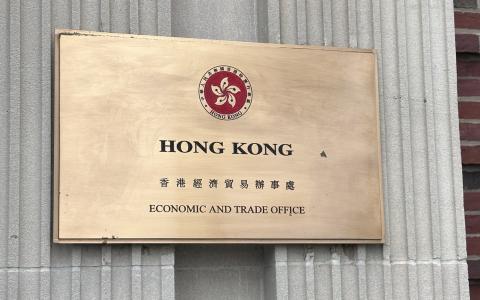
The Chairs and Ranking Members of the Commission introduced the Hong Kong Economic and Trade Offices Certification Act (H.R. 2661/S. 3655) in the 119th Congress, which would revoke certain existing privileges, exemptions, and immunities of HKETOs in the United States. As Commission Co-chair Smith said regarding the bill, “HKETOs are pushing out Chinese Communist Party propaganda and spying on Hong Kongers living in the United States—this must stop. Beijing should not have three extra diplomatic posts in the United States to do its bidding.”
Bookstore Arrests in Hong Kong
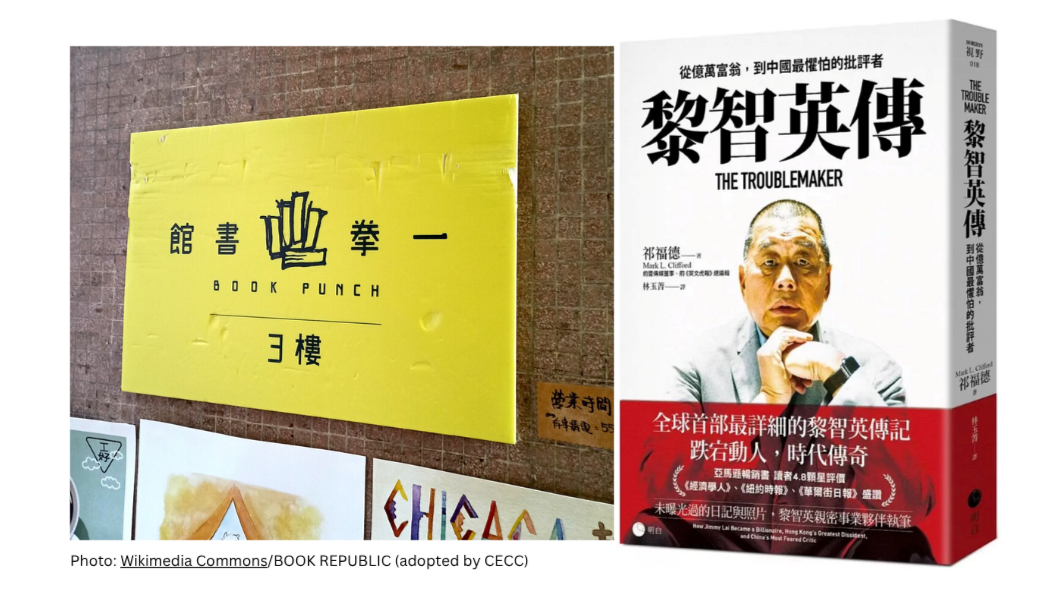
Even after the conviction of pro-democracy newspaper founder Jimmy Lai, Hong Kong authorities have continued to pursue people, property, and publications connected to him, showing how national security enforcement is being used not only to punish dissent but also to suppress information about him. In March 2026, police raided a bookstore called Book Punch and seized titles including a biography of Jimmy Lai. Owner Pong Yat-ming and three employees were arrested on suspicion of selling seditious print materials and were released on bail shortly thereafter. News outlet The Standard, which the biography’s author described as a conduit for government messaging, characterized the book as seditious because it glorified Lai’s collusion with foreign forces, attacked Hong Kong’s judicial personnel, and vilified the Hong Kong and PRC governments. The Associated Press highlighted the broader issue that similar independent bookstores offering titles deemed politically sensitive face multiple challenges. One bookseller noted that compliance is difficult because authorities have not provided a list of prohibited books.
The Book Punch raid took place within the context of continued national security law enforcement. In March, the government de-registered three companies affiliated with Apple Daily, a pro-democracy news outlet founded by Jimmy Lai, and declared them “prohibited organizations.” This move exposes any person working for, or giving aid to, these organizations to potential imprisonment of up to 14 years, along with substantial fines. In April, the government sought to forfeit Jimmy Lai’s assets, the value of which was undisclosed but which was reportedly estimated at over US$16 million.
At the same time, the government broadened enforcement powers by amending the implementing rules for the Safeguarding National Security Ordinance, also known as the Article 23 Ordinance, to allow police to compel people to unlock their electronic devices and decrypt contents stored therein. As described by the Taipei Times, “[t]here was no legislative debate, no public consultation and no transition period,” effectively evading the traditional lawmaking process at the Legislative Council. Refusal to comply may lead to imprisonment of up to one year and a fine of HK$100,000 (approximately US$12,000). The amendment also grants customs officers the power to seize seditious items based on reasonable suspicion. Secretary for Security Chris Tang Ping-keung, addressing concerns about arbitrary requests, stated that a warrant would be required for conducting searches. The rules, however, provide for an exception that allows police to conduct warrantless searches if it is not reasonably practicable to obtain a warrant for any reason.
PRC Influence Evident in Ruling on Protest Case in Kazakhstan
Kazakhstan convicted 19 people tied to Atajurt, a rights group that documented the detention of ethnic Kazakhs in China, in a verdict widely criticized as criminalizing peaceful protest and raising questions about China’s influence over Kazakhstan’s courts. The ruling was the harshest blow yet to Kazakhstan-based advocates challenging China’s abuses in the Xinjiang Uyghur Autonomous Region. Rights groups had called for the charges against the defendants to be dropped. The defendants were detained in November 2025 after they protested on behalf of a citizen of Kazakhstan detained in China last July. The closed trial, which began in January 2026, was held four hours by car from the location where the defendants lived. The health of several defendants, including those sentenced to prison, reportedly worsened while they were in pre-trial detention.
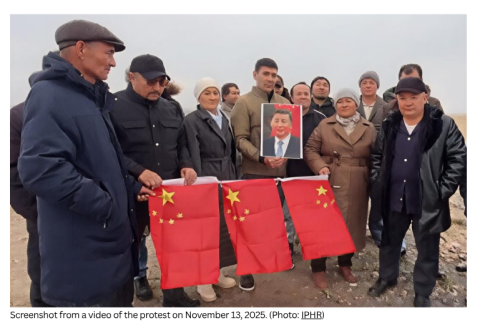
In a final hearing on April 13, 2026, a court in the city of Taldykorgan found all 19 protesters guilty of “inciting ethnic or national discord,” sentencing 11 individuals to five years’ imprisonment and 8 others to “restriction of liberty,” which entails state-imposed restrictions on their freedom of movement and residence. Atajurt leader Bekzat Maksutkhan was among those sentenced to prison. The court deferred the prison sentences of two female defendants who had minor children. One of the two women whose sentences were deferred, Guldariya Sherizat, is the wife of Alimnur Turganbay, a truck driver and citizen of Kazakhstan who was detained by PRC authorities in July 2025 and was the subject of the protests. (See CECC Monitor #3 for more detail on the protests and the PRC’s efforts to influence the case.)
Rising Mass Protests Reflect Chinese Resilience Under Censorship
Mass protests in China continued an upward trend in early 2026, despite authorities maintaining tight control over information related to collective action. An image of a gray-haired elderly woman in a pink outfit throwing stones and eggs at police became emblematic of protests in March in Xinyi City, Guangdong Province. The video circulated widely on X after numerous videos of the protests were censored and removed from Douyin (China’s domestic version of TikTok). According to reports, hundreds of residents protested between March 17 and 19 after the municipal government issued a notice for a proposed crematorium project on March 16. Residents alleged authorities had previously described the land requisition as intended for road construction. On March 25, before the consultation period ended, hundreds again gathered to protest; some participants were reportedly beaten and detained, with several held for up to 10 days on charges of “picking quarrels and provoking trouble.”
Efforts at documenting protests by Yesterday and Freedom House’s China Dissent Monitor (CDM) have helped fill critical information gaps resulting from PRC government censorship and the risks of tracking protests inside China. Data provided to the Commission by CDM indicate that at least 1,241 protests occurred in the first quarter of 2026—an 18.6 percent increase from 1,046 in the same period in 2025.
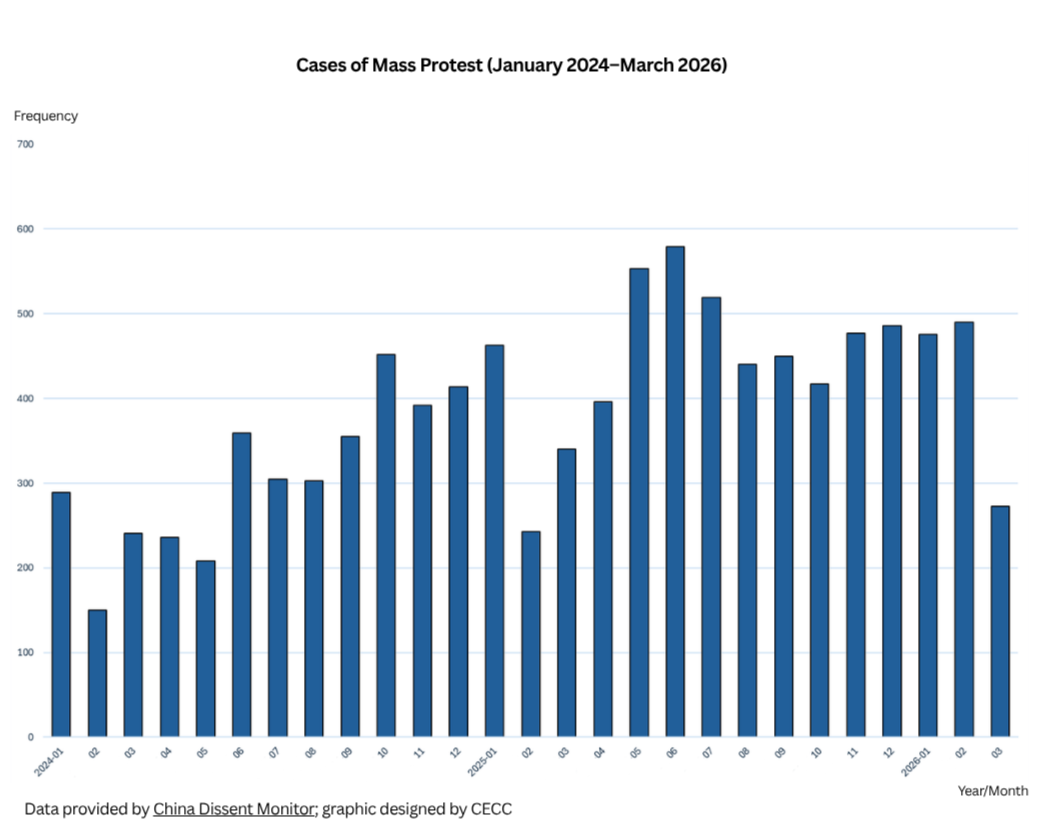
Over the year 2025, CDM recorded at least 5,363 protest events in total, a 45 percent increase over 2024. Workers accounted for nearly half of protest activity (47 percent), followed by property owners and buyers (26 percent) and rural residents (14 percent), with the largest number of protests occurring in Guangdong province (17 percent).
The resilience of the Chinese people is likely even stronger than the documented figures suggest. Kevin Slaten, research lead at CDM, told the Commission that a coordinated censorship campaign, named the “clear and bright campaign,” (qinglang yundong, 清朗运动) led by the Cyberspace Administration of China (CAC) and beginning around the Lunar New Year, likely reduced the visibility of protest-related information. The protest figures were also believed to be lower than the actual numbers due to a suspension of U.S. foreign assistance funding in 2025 that forced a five-month halt in CDM’s operations before its relaunch in July 2025. Even with the large increase in protests in 2025, Slaten noted that the numbers—particularly for non-economic protests—are also further undercounted from the second half of 2025 through to the present, due to the impact of last year’s funding termination on CDM’s capacity.
China’s sweeping new Ecological and Environmental Code promises a more centralized, government-led approach to environmental protection, but legal experts warn that it narrows the public’s power to hold polluters—and the government itself—accountable. With the stated aim of “protect[ing] the ecological environment and promot[ing] green development,” China’s National People’s Congress moved in March to elevate ecological and environmental law to an official branch of Chinese law and pass the PRC Ecological and Environmental Code. One legislator expressed that establishment of environmental law as an independent branch of Chinese law unites different categories of environmental law under a guiding framework and could encourage greater academic study and specialization of legal talent. The Code addresses three new types of pollution—chemical substances, non-ionizing radiation, and light pollution—and offers a general legal framework for China’s climate governance, but its full impact will remain unknown until it goes into effect on August 15, 2026.
While the Code might appear to be a promising development for addressing pollution, public health, biodiversity, and other environmental issues, legal experts warn that it significantly weakens environmental public interest litigation (EPIL), a critical accountability mechanism in the public’s toolkit, by restricting the types of cases nongovernmental organizations (NGOs) can file and establishing new burdensome evidentiary requirements for plaintiffs.
Article 147 of the Code explicitly restricts EPIL to civil cases, namely litigation against individuals or companies for inflicting environmental harm, stripping NGOs of the right to file administrative EPIL cases against the Chinese government for misconduct or failure to uphold its legal obligation to protect the environment. In addition, Article 1081 further constrains EPIL by requiring NGOs to both prove that environmental damage has already occurred and certify the cost of the environmental loss and restoration at the time of filing. Feng Ge, an environmental lawyer who successfully led EPIL cases when working for Chinese environmental NGO Friends of Nature, cautions that this evidentiary burden could delay, or deter NGOs from pursuing, some EPIL cases and hamper lawsuits intended to stop environmental destruction before it occurs.
Historically, EPIL has been a critical tool for NGOs to defend the public interest by challenging individuals, corporations, and government entities complicit in cases of pollution and ecological destruction. With China still facing problems of air pollution and a record-high number of coal burning plants in the pipeline for construction, the Code’s restrictions on EPIL impair a critical legal mechanism at the public’s disposal for protecting public health and the environment.
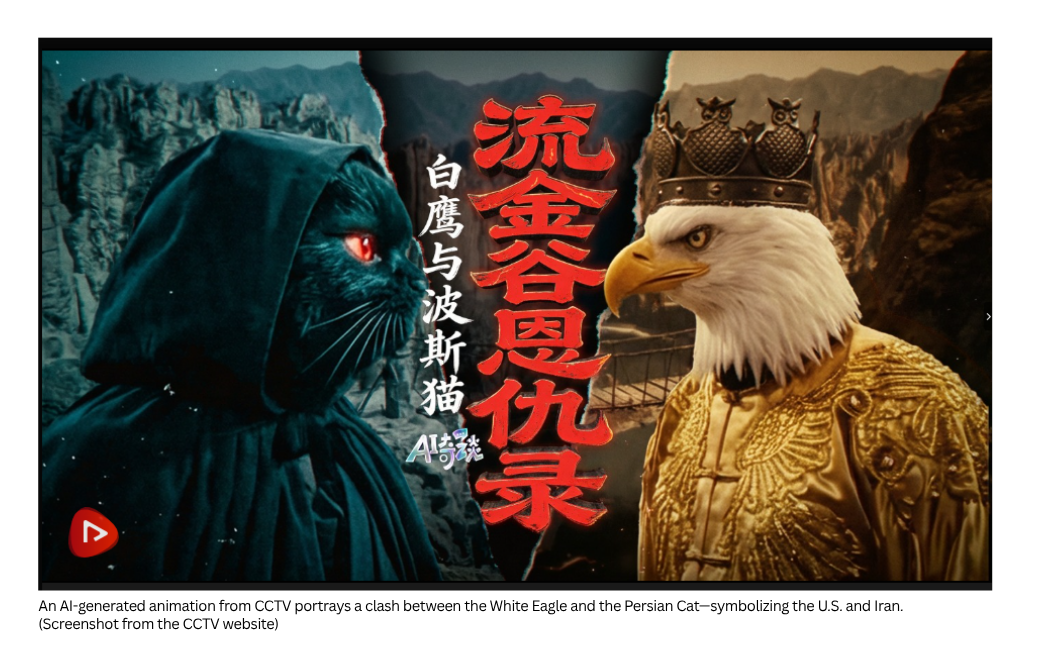
Artificial intelligence (AI) has the potential to enhance production and dissemination of propaganda, to counter opposing political narratives, and to make it hard to discern fact from fiction. One example of the increasing sophistication of AI-generated messaging is a recent PRC state media outlet China Central Television (CCTV) video featuring battling eagles and Persian cats to depict the conflict in Iran. The CCTV video is significant not only because it shows PRC state media experimenting with AI-generated propaganda, but because the experiment appears to have made the CCP’s messaging more engaging, shareable, and visible. By using vivid AI-generated imagery to frame the Iran conflict, CCTV helped package a familiar CCP narrative—that the PRC is a stabilizing power while the United States drives instability—in a form that reportedly drew high domestic viewership and uncommon international media attention. If AI can help overt state media messaging land more effectively, it could also make covert influence operations more persuasive, scalable, and harder to detect. That concern is especially relevant to the covert PRC-linked network commonly referred to as “Spamouflage,” also known as “Dragonbridge.”
Unlike other malign influence operations that have been indirectly linked to China, the network commonly referred to as “Spamouflage” has been linked by Meta to individuals associated with Chinese law enforcement. Although not naming Spamouflage directly, in April 2023 the U.S. Department of Justice charged 40 Ministry of Public Security officers in connection with other transnational repression schemes that used “fake social media accounts,” highlighting PRC direct state involvement in coordinated online campaigns.
PRC-linked influence operations targeting U.S. elections show increasing integration of AI tools. The U.S. Intelligence Community assessed that the PRC did not attempt to interfere in the 2020 presidential election, but Graphika reported Spamouflage had used AI-generated profile pictures to post English-language videos focused on U.S. policy and the Trump Administration. The PRC attempted to influence a handful of races in the 2022 midterm elections, and Mandiant observed Spamouflage posting political content to disincentivize Americans from voting by portraying the U.S. Government as not efficient or accountable. During the 2024 Presidential election, Spamouflage used AI-generated content to spread doubt about election legitimacy, promote disruptive narratives on social issues, and make character attacks against former President Joe Biden, President Donald Trump, and former Vice President Kamala Harris.
As is typical of Spamouflage, the influence operations around the 2020, 2022, and 2024 elections apparently did not gain much traction, but the integration of AI into PRC influence operations represents an evolution of existing tactics, with evidence of growing use. While to date these efforts have had limited effectiveness, the viral AI-generated CCTV video about the Iran conflict suggests that PRC actors may be improving their ability to produce content that resonates across audiences.
Political Prisoner Case—Gao Zhen (高兟)
CECC Political Prisoner Database record number 2024-00161
The Sanhe City People’s Court in Hebei province held a closed trial in March for New York-based artist Gao Zhen on charges of “insulting or slandering heroes and martyrs.” Gao’s wife, Zhao Yaliang, reported that the trial lasted one day and that she was banned from attending. Gao has reportedly been deprived of food while in detention and suffers from multiple medical conditions.
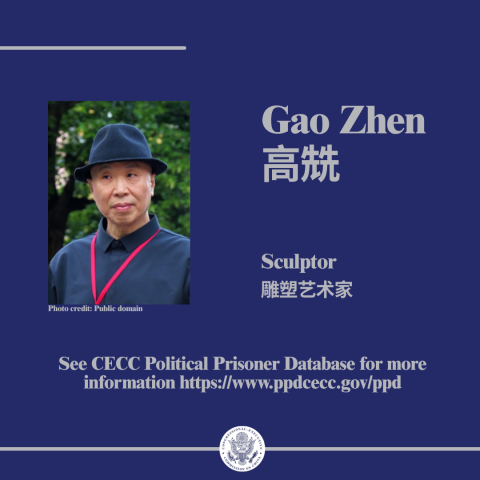
Gao and his brother, Gao Qiang, are best known for having created satirical artwork that sometimes depicted Mao Zedong in provocative ways. The works that authorities have singled out for criticism were all created before the charge of insulting heroes was adopted in 2018 and revised in 2021.
Gao, a U.S. resident, was initially detained in August 2024 while he was visiting China with his wife and his son, who is a U.S. citizen. At the time, authorities raided the studio in Sanhe city near Beijing belonging to Gao Zhen and his brother, confiscating artwork, books, and computer hard drives. Since August 2024, Zhao and the couple’s son have been under exit bans and unable to leave China.
Gao Zhen was included in a letter the Commission’s Chairs and ranking members sent to President Trump ahead of his trip to China, urging the President to raise individual cases in his engagements with Xi Jinping. The Commission’s Chairs noted that “[r]aising political prisoner cases at the highest levels is a low-cost, high-return instrument that raises the price of repression, denies the CCP a cheap tool of leverage, and makes clear that the United States will address arbitrary detention and family intimidation in the normal course of bilateral relations.”