China Monitor #6
A publication to keep Members of Congress and the public informed about critical human rights and legal developments in China
July 10, 2026
Contents:
- Pastor Ezra Jin Released
- Hearing on the CCP’s Long Arm in the United States
- Chow Hang-tung Defends the Right to Remember Tiananmen in Hong Kong
- China’s Ethnic Unity Law Takes Effect
- Major Fire in Hong Kong Highlights Gaps in Protection for Migrant Domestic Workers
- Cancellation of RightsCon
- Crackdown on Church Sunday School in Guizhou Reflects Growing Insistence on Ideological Conformity for Youth
- Coal Mine Explosion Kills Dozens Despite Known Safety Red Flags
- Highlighted Political Prisoner Cases
After more than 260 days of detention, Pastor Ezra Jin arrived in the United States on July 3 and was reunited with his family, a significant development following President Trump's May visit to Beijing. Welcoming Jin's release, CECC Co-Chair Chris Smith stated, “I especially thank President Trump for personally raising Pastor Jin's case with CCP General Secretary Xi Jinping and for ensuring that U.S. diplomats remained committed to pressing for his freedom.”
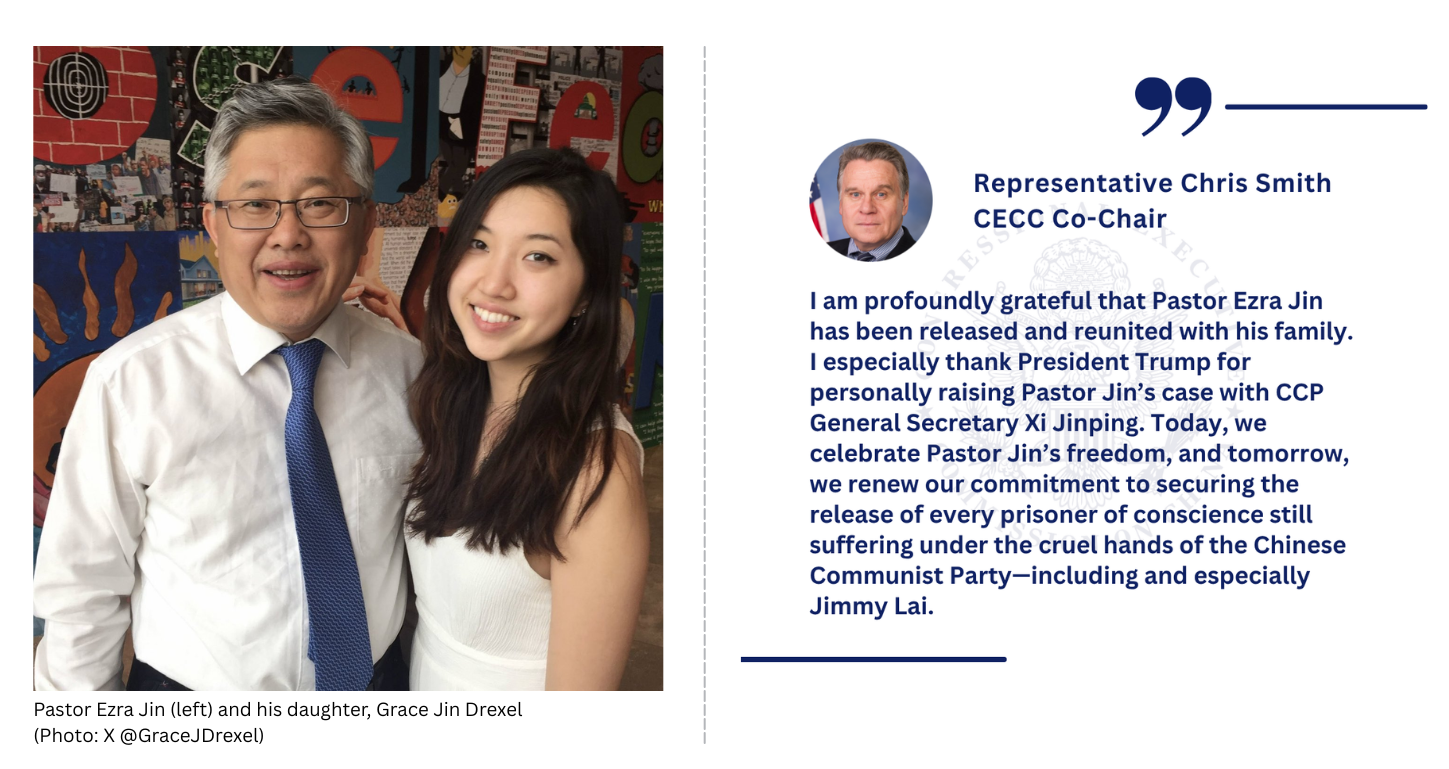
Representative Smith and Grace Jin Drexel, Pastor Jin's daughter, have urged continued public attention on eight additional leaders of Zion Church who remain in custody. In an open letter, the Zion Church leadership team and the families of the detained church leaders called on Chinese authorities to release all those still imprisoned.
The Commission has consistently prioritized Pastor Jin's case. Ahead of President Trump's May trip to Beijing, the Chairs urged the President to raise Jin's imprisonment directly with Xi and to press for his release. The CECC also featured testimony from Drexel at a hearing examining the CCP's escalating assault on freedom of religion or belief in 2025.
Hearing on the CCP’s Long Arm in the United States
At a June hearing, the Commission examined how the People’s Republic of China (PRC) uses transnational repression to silence U.S.-based critics, diaspora communities, students, journalists, and religious and ethnic minorities. Commissioners heard testimony describing surveillance, threats to family members, Hong Kong national-security bounties, intimidation of protesters, campus pressure, and alleged foreign agent activity on U.S. soil.
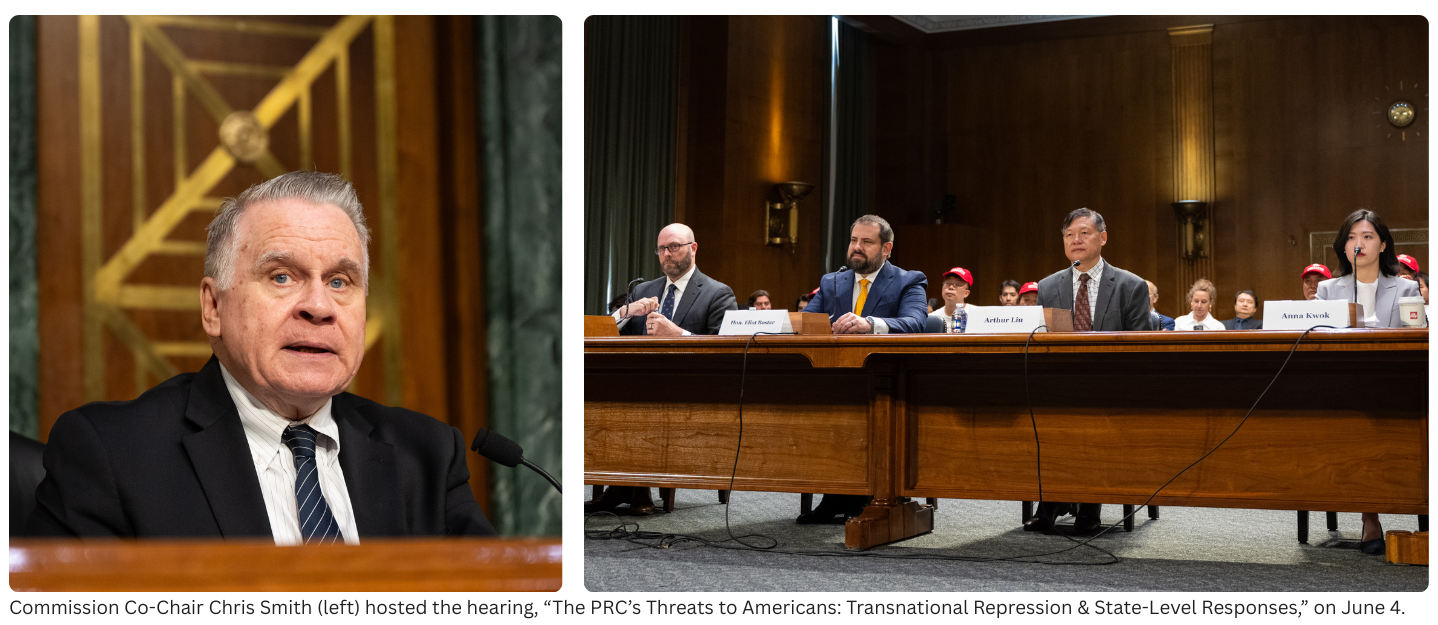
Witnesses underscored the human cost of the PRC’s transnational repression. Hong Kong democracy advocate Anna Kwok described living under a HK$1 million bounty and testified that her father was arrested and imprisoned in Hong Kong in retaliation for her advocacy. Arthur Liu, a former Tiananmen-era student activist and father of Olympic figure skater Alysa Liu, described a PRC-linked intelligence operation that sought passport and personal information about him and his daughter before the 2022 Beijing Winter Olympics.
The hearing also focused on states’ responses. Nebraska State Senator Eliot Bostar described laws creating foreign-adversary registration requirements, enhanced penalties for transnational repression, and prohibitions on unauthorized foreign law-enforcement activity. Stephen Cox, Counsel to the Governor of Alaska , argued that states can use consumer protection, licensing, data security, and infrastructure authorities to reduce foreign-adversary leverage.
Commission leaders highlighted pending federal legislation, including the bipartisan Transnational Repression Policy Act (S. 2525/H.R. 4829) which would define transnational repression, improve interagency coordination, train federal, state, and local officials, support targeted communities, and strengthen accountability. The hearing emphasized that transnational repression is both a human rights abuse and a homeland security threat as the CCP’s effort to make people afraid to speak freely does not stop at China’s borders.
Chow Hang-tung Defends the Right to Remember Tiananmen in Hong Kong
On May 19, in a national security trial, lawyer and pro-democracy activist Chow Hang-tung (鄒幸彤) defended her right to continue a decades-long practice of organizing June Fourth vigils in Hong Kong in remembrance of the violent suppression of the 1989 Tiananmen Square protests. In September 2021, Chow, along with former legislators and pro-democracy activists Lee Cheuk-yan and Albert Ho Chun-yan, all organizers of the Hong Kong Alliance in Support of Patriotic Democratic Movements of China, were arrested and later charged with “inciting subversion of state power.” Chow, a lawyer who is representing herself in court, and Lee, continue to plead not guilty.
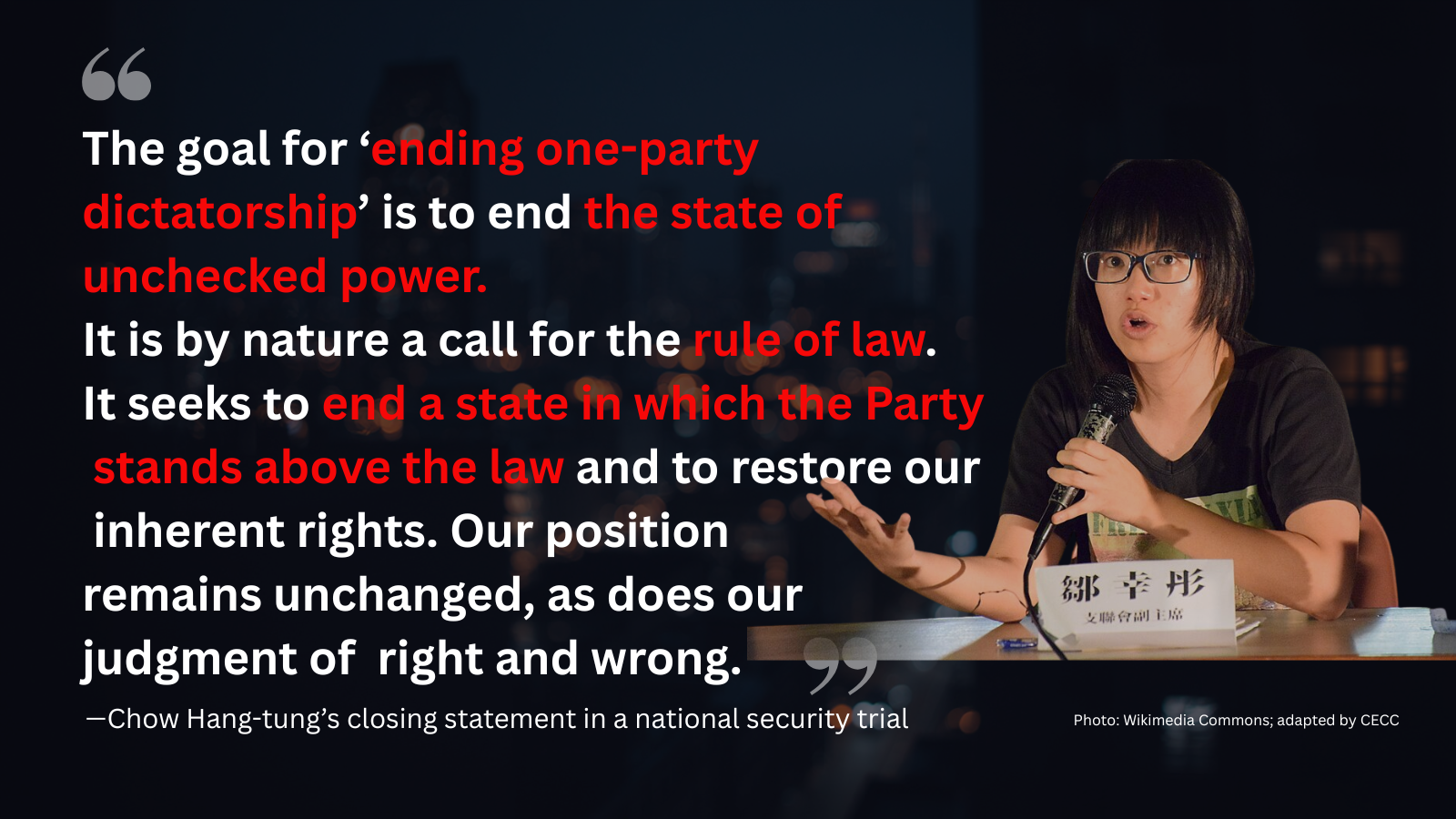
In her closing statement, Chow challenged the Communist Party’s one-party dictatorship and restated that the goal is to “bring about a democratic transition, and effect a change of regime.” In place of the annual June Fourth candlelight vigils, for the past four years, Victoria Park has hosted a food carnival on the former commemoration grounds, in an attempt to erase its political significance. Police regularly patrol the vicinity on the anniversary to stop any tribute to the victims of the June 4, 1989 crackdown, including this year when they stopped, searched and briefly detained seven people for “disrupting order”; they were engaging in activities such as tying a red thread to a sign post, holding a yellow flower, and holding up the PRC Constitution blindfolded.
China’s Ethnic Unity Law Takes Effect
The PRC Law on Promoting Ethnic Unity and Progress (Ethnic Unity Law), which took effect on July 1, 2026, gives legal force to Xi Jinping’s campaign to “forge the common consciousness of the Chinese nation” by elevating Mandarin Chinese, policing expressions of ethnic identity, mandating the sinicization of religion, and asserting jurisdiction over overseas groups and individuals accused of undermining “ethnic unity and progress.”
Key provisions of the law include:
Establishing the primacy of Mandarin Chinese in education and government. The law mandates the promotion of Mandarin Chinese as the national language and emphasizes the importance of the Xi-promoted phrase “forging the common consciousness of the Chinese nation” (zhulao zhonghua minzu gongtongti yishi, 铸牢中华民族共同体意识).
Reporting acts that harm ethnic unity. Under Article 54 of the law, citizens are permitted to report conduct that undermines “ethnic unity and progress,” including the failure of government agencies and staff to adequately perform relevant obligations. A group of UN experts noted that this article “could allow for false or politically motivated accusations, community-level surveillance, and pressure to conform to society expectations.”
Assertion of jurisdiction over foreign groups and individuals. Article 63 of the law stipulates that PRC authorities have jurisdiction over groups and individuals outside of China and those who are not Chinese citizens who engage in acts that “harm ethnic unity and progress or create ethnic division.” The U.S.-based NGO International Campaign for Tibet wrote that the law “directly contravenes established principles of international law, including territorial sovereignty of the relevant state and international human rights guarantees.”
In addition, Article 46 of the law mandates the continuation of the “sinicization of religion,” likely indicating intensified CCP and government efforts to control and limit the religious practices of ethnic minority groups. Under “sinicization,” the Party and government have imposed restrictions on expressions of religious faith, including for Tibetan Buddhists and Turkic Muslims.
The PRC has made international commitments to protect cultural expression, educational rights, and community life that the Ethnic Unity Law may violate. For example, it may violate Article 5 of the PRC’s ratified commitment to the International Convention on the Elimination of All Forms of Racial Discrimination (ICERD), which guarantees the right to freedom of thought, conscience, and religion.
The law’s passage followed the December 2025 passage of a revised version of the PRC Law on the Standard Spoken and Written Chinese Language, which took effect on January 1, 2026, and which requires schools to use “unified state-compiled textbooks.”
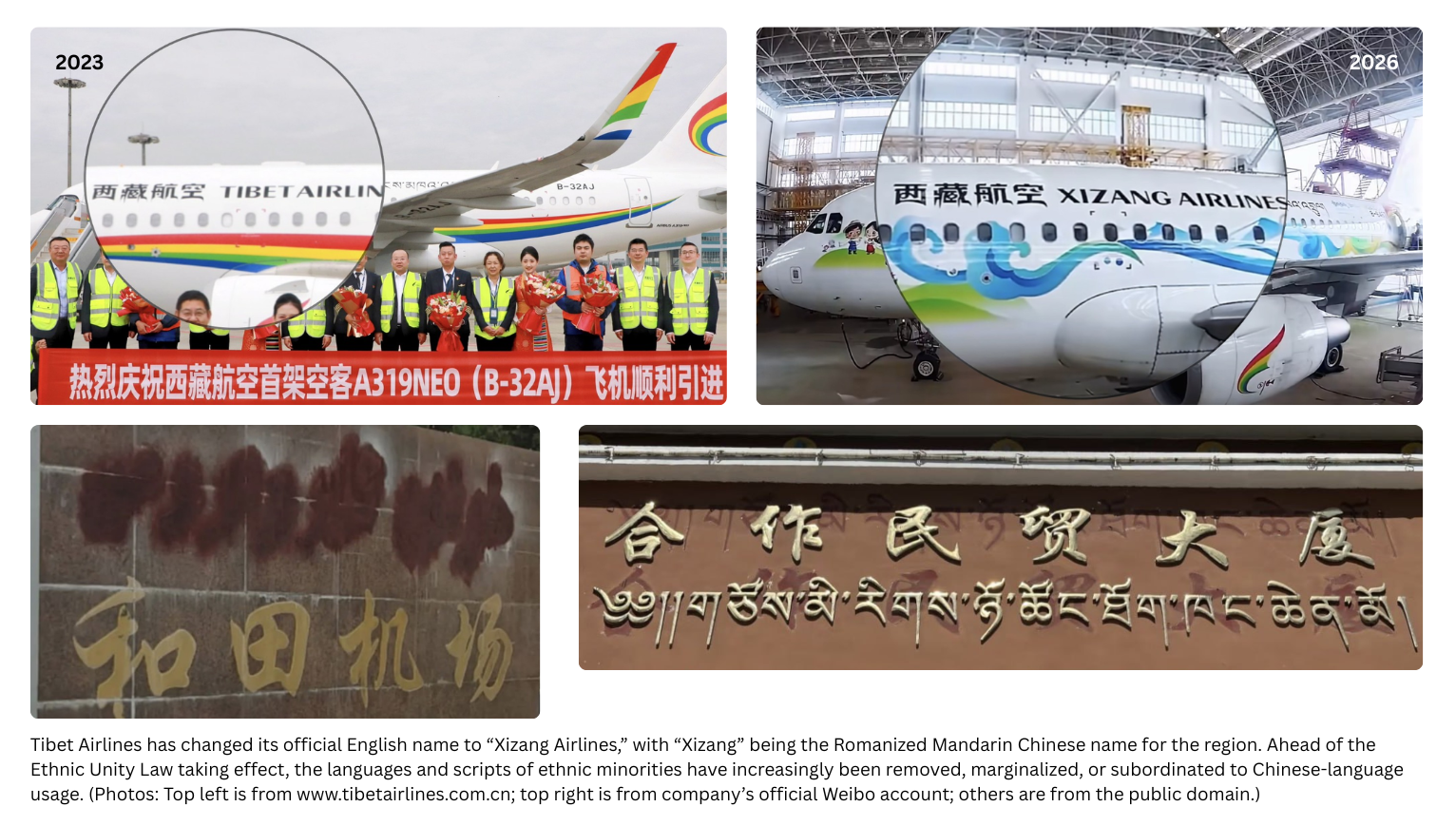
Together, these laws institutionalize policies aimed at eliminating the expression of linguistic, cultural, and religious characteristics of the country’s 55 non-Han ethnic groups. (See this Commission Analysis from December 2025 for more detail on the Ethnic Unity Law and its implications.
In response to the law’s implementation, CECC Co-Chair Chris Smith (R-NJ) and Commissioner James McGovern (D-MA) introduced a resolution (H.Res 1400) condemning the Ethnic Unity Law as a vehicle for cultural and religious erasure, forced assimilation, and transnational repression. The resolution urges sanctions on responsible PRC officials and entities, stronger protections for diaspora communities in the United States, support for endangered languages and religious traditions, and continued advocacy for prisoners of conscience targeted for defending faith, family, language, and cultural identity.
Major Fire in Hong Kong Highlights Gaps in Protection for Migrant Domestic Workers
A major fire in Hong Kong brought into focus the often overlooked structural vulnerabilities faced by migrant domestic workers (MDWs), officially referred to as “foreign domestic helpers” in Hong Kong for immigration and employment law purposes. The fire broke out in November 2025 in the Wang Fuk Court residential complex, killing 168 people and injuring 79. It occurred on a weekday afternoon, when mostly seniors and young children, some of whom were cared for by MDWs, remained at home. According to a government official, 235 MDWs were employed at Wang Fuk Court; 10 died and 3 were injured in the fire. Eight of the deceased died alongside the individuals they cared for. Sri Wahyuni, for example, was found dead by rescuers while still embracing her 93-year-old employer. Vame Mariz Wayas Verador survived the fire, after helping a toddler and his grandmother escape, but her employer terminated the employment contract, creating uncertainty regarding her future employment and housing.
Besides Verador, about 20 other surviving MDWs had their employment contracts terminated after the fire. In addition to being displaced, they faced further hardship due to regulatory restrictions, including those that require them to live with their employers and to leave Hong Kong within two weeks after the termination of their employment contracts (two-week rule). While the government made an exception for the fire and extended the period for finding a new employer to three months, some surviving MDWs reported that they had not recovered from the trauma and struggled to adapt to new employment. A social worker highlighted a systemic problem wherein MDWs were not treated as independent stakeholders, noting that they would need their employer’s permission even to access the fire-damaged apartments and recover their belongings. Verador’s employer, for example, reportedly was unwilling to grant her such access.
While the fire created immediate hardships for affected MDWs, it also highlighted broader and longstanding labor rights vulnerabilities. According to the International Domestic Workers Federation (IDWF), the Standard Employment Contract lacks key safeguards relating to privacy, rest time, and protection against passport confiscation. Under the standard contract, MDWs, as mentioned above, are required to live with their employers full-time without any statutory limitations on work hours. Also, some MDWs take out substantial and potentially illegal loans before leaving their home countries to cover recruitment fees, and travel and training expenses, which, according to IDWF, forces many of them to “endure abuse and the loss of basic rights rather than risk losing their livelihoods.” The 2025 U.S. Trafficking in Persons Report found that the live-in requirement and the two-week rule increased “workers’ vulnerability to exploitation by abusive employers and unscrupulous employment agencies,” and called for their repeal, consistent with the recommendation made by the U.N Committee on the Elimination of Discrimination against Women.
The Zambian government abruptly “postponed” the digital rights conference RightsCon shortly before it was scheduled to begin, effectively canceling the event. The annual conference expected more than 3,700 attendees at forums discussing topics such as human rights on the internet, censorship, and surveillance. RightsCon staff reported that the Zambian Ministry of Technology and Science (MoTS) informed organizers on April 27, just over a week before the conference’s scheduled start date, that the People’s Republic of China (PRC) was applying diplomatic pressure because of the planned attendance of participants from Taiwanese civil society. Multiple sources also indicated to RightsCon staff that certain topics and communities, including Taiwanese participants, would have to be excluded in order for the event to proceed. On April 28, local Zambian state-owned media announced the “postponement” of RightsCon. The MoTS explained that the “postponement” decision was made because of a need for “disclosure of critical information … to ensure alignment with Zambia’s national values, policy priorities, and broader public interest ….” At the time of publication, no new date had been announced.
Although no public statement from the Zambian government directly attributed the cancellation to PRC pressure, the RightsCon program included several topics that the PRC government considers politically sensitive, including Uyghur forced labor, the export of PRC censorship technologies, surveillance and the Digital Silk Road, digital authoritarianism, and PRC foreign information manipulation and interference (FIMI) activities. The planned panel on FIMI included representatives from Doublethink Lab, a Taiwan-based organization that researches PRC influence operations. PRC authorities have targeted the organization’s co-founder, Puma Shen, through measures including sanctions imposed by the PRC Taiwan Affairs Office and a criminal investigation for separatism announced by the Chongqing Municipal Public Security Bureau.
The cancellation of RightsCon happened in the context of both long-standing influence of the PRC in Zambia, and an upcoming Zambian election in August. In 2023, Zambia entered into a comprehensive strategic partnership with the PRC, following decades of Chinese infrastructure loans resulting in significant Zambian debt. Some, however, argued that the decision was linked instead to the upcoming Zambian election in August and broader government efforts to tighten political control before voting.
The reported efforts to restrict the participation of Taiwanese civil society organizations and exclude certain discussion topics are consistent with broader PRC efforts to shape international discussions involving issues that the PRC considers related to sovereignty, territorial integrity, and political control. RightsCon has long served as a venue for advancing the multistakeholder model of internet governance, which emphasizes participation by civil society, technical experts, private-sector actors, and governments in open and transparent decision-making processes. By contrast, the PRC promotes the concept of cyber sovereignty, which emphasizes the authority of states to regulate and govern the internet within their borders according to national conditions and priorities.
The Chinese Communist Party is increasingly treating the inclusion of children in religious life as a threat to state control. In May 2026, news broke that PRC authorities had charged six members of a Protestant house church in Kaili city, Guizhou province with “fraud,” a familiar pretextual charge used against house churches, as well as with “organizing minors to engage in activities harming public security administration”—a charge typically used for public order offenses, not Sunday school classes. This case marks the first time public security provisions related to minors have been invoked in Party efforts to criminalize normal religious activities, but it is unlikely to be the last. Nor is it the only evidence of a growing intolerance for youth participation in church activities. An April 2026 report by Human Rights Watch documented stricter enforcement in the official Chinese Catholic Church, underscoring a broader Party objective: to weaken intergenerational religious ties and expand its monopoly on the moral and ideological development of China’s youth.
This is nothing new to Tibetans or Uyghurs: authorities have long policed minors’ religious activities and education in Tibetan areas and in the Xinjiang Uyghur Autonomous Region (XUAR). For years, they have removed minors from Tibetan Buddhist monasteries, which have trained youth as Buddhist monks or nuns for centuries. And as part of the brutal crackdown on Uyghurs and other Turkic Muslims in the XUAR, officials have engaged in ruthless campaigns to root out religious education, even detaining adult relatives for teaching children in their own homes.
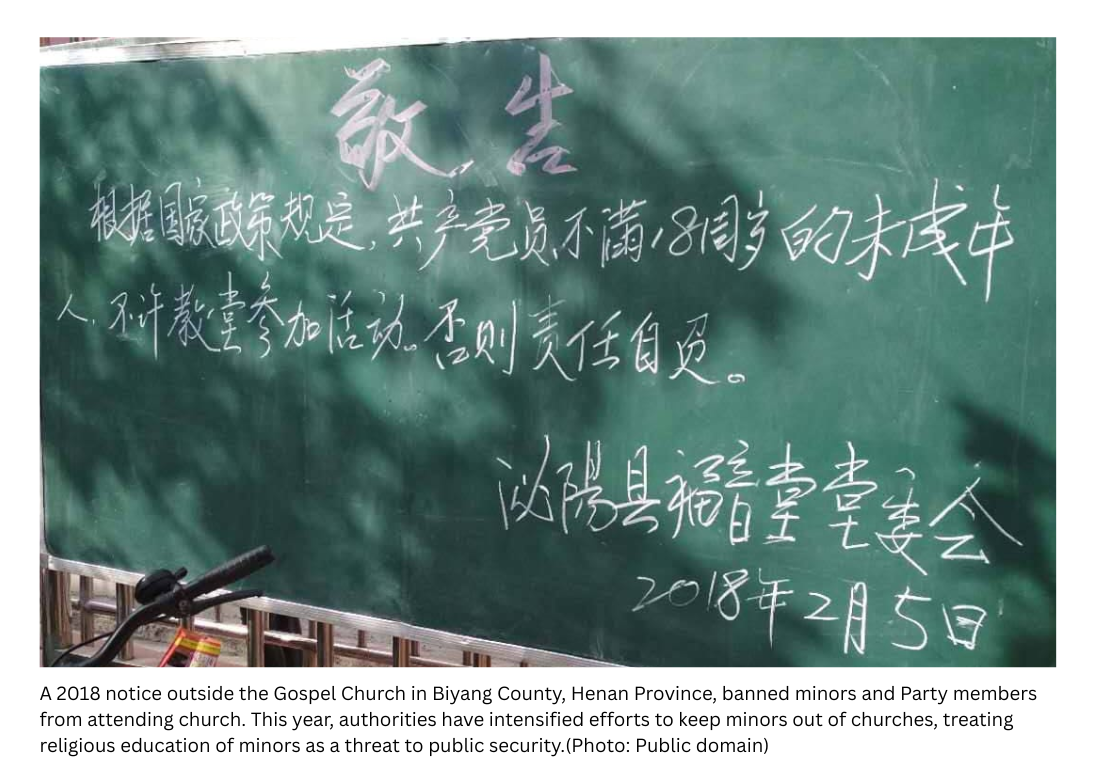
The crackdown in Kaili takes these timeworn tactics into new territory, targeting Christians alongside groups that have endured years of persecution merely for attempting to pass on their faith, as is their fundamental human right. These developments may also get at something else: the Chinese Communist Party’s insistence on ideological conformity and Party loyalty among children and youth. In December 2025, Politburo Standing Committee Member Cai Qi addressed the Symposium on the Work of Ideological and Moral Development of Minors, saying that Xi Jinping viewed this work as a “strategic and fundamental task.” In the face of an ongoing youth unemployment crisis and a slew of persistent memes speaking to youth discontent, the Party sees it as more important than ever that they “pass on the red gene” to children and young adults, rather than allowing families and churches to pass on an alternative narrative.
Coal Mine Explosion Kills Dozens Despite Known Safety Red Flags
In one of the deadliest mining accidents in recent years, 82 people were killed in a gas explosion on May 22, 2026, at a coal mine in Changzhi municipality, Shanxi province. Two people were missing and 128 required hospitalization. The accident renewed concerns about government oversight failures at a worksite with documented safety risks and regulatory violations.
The mine, known as the Liushenyu Coal Mine, was run by a subsidiary of Shanxi Tongzhou Coal & Coke Group (Tongzhou Group). Following the incident, authorities placed several officials under investigation, detained people in leadership positions at Tongzhou Group, and ordered the company to suspend operations at all four of its coal mines due to alleged violations. More broadly, the government ordered nationwide gas-hazard inspections, after which coal production was suspended at 109 of 887 coal mines in Shanxi, as well as in other provinces.
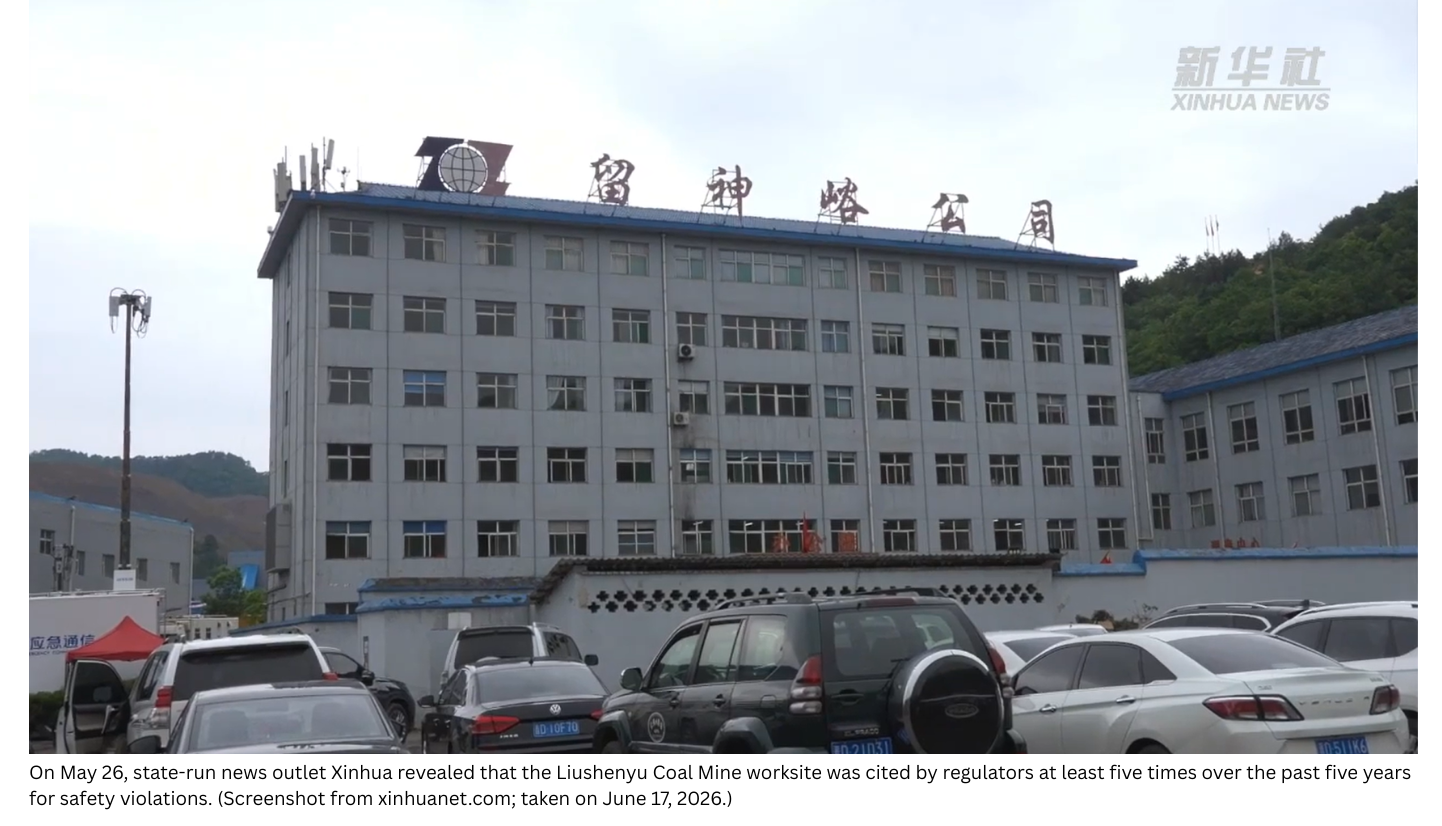
State-run news outlet Xinhuarevealed that the Liushenyu Coal Mine worksite was cited by regulators at least five times in the past five years for safety violations, including for maintaining concealed mining areas. In 2024, the National Mine Safety Administration placed the Liushenyu Coal Mine on its list of mines with “severe hazards,” identifying it as a “high-gas mine.” Despite these known risks and violations, the Liushenyu Coal Mine was designated as a B-grade mine, meaning that it had an average level of safety protection. The designation also meant that regulators considered the mine to have established reliable disaster-prevention and emergency-escape systems.
The incident, however, exposed a range of practices inconsistent with the designation. For example, gas sensors reportedly had been tampered with, and some miners were given emergency breathing devices that were either broken or had substandard oxygen supply. Over 40 percent of the 247 miners working on the day of the incident were not carrying a real-time positioning device as required by law. Rescue efforts were complicated by the mine’s under-reporting of the number of working miners, likely connected to mining activities conducted in concealed areas that were not reflected in official records.
The fragmented employment arrangement at the Liushenyu Coal Mine raises additional concerns regarding worker safety and protection. Many workers there did not have a direct labor relationship with the mine, as they were hired through various outsourcing companies from provinces outside of Shanxi. Depending on the findings of the official investigation, this employment arrangement may constitute a major accident hazard under national mine safety standards. Outsourced labor (laowu waibao, 劳务外包)—under which the contractor, rather than the principal, generally manages the workforce—is not a statutorily defined labor category and is not expressly prohibited from engaging in underground coal mine work. This bifurcation of responsibilities may complicate accountability because workforce management is delegated to outsourcing companies while the mine remains legally responsible for key safety measures, including providing workers with safety training.
Highlighted Political Prisoner Cases—Tsering Drolma (ཚེ་རིང་སྒྲོལ་མ་) and Gangkye Drubpa Kyab (གངས་སྐྱེས་སྒྲུབ་པ་སྐྱབས་)
CECC Political Prisoner Database record number 2022-00163 and 2012-00092
Two Tibetan political prisoners in Sichuan are reportedly in critical condition after suffering torture and mistreatment in custody during repeated detentions across nearly two decades combined.
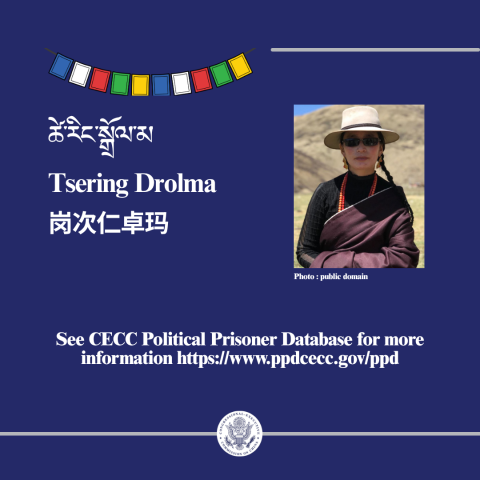
On March 23, 2021, public security officials in Serthar (Seda) county, Kardze (Ganzi) Tibetan Autonomous Prefecture (TAP), detained writer and teacher Gangkye Drubpa Kyap, and on April 2 detained Tsering Drolma, a Tibetan activist from Serthar. In September 2022, the Kardze TAP Intermediate People’s Court sentenced them and four other prominent Tibetan intellectuals and former political prisoners to prison terms ranging from 4 to 14 years on charges including “inciting separatism.” Tsering Drolma was sentenced to 8 years; Gangkye Drubpa Kyab to 14 years; Samdrub to 8 years; monk Gangbu Yubum to 7 years; writer and teacher Senam to 6 years; and writer Pema Rinchen to 4 years. All six were detained in Kardze TAP between late 2020 and spring 2021. Information on where authorities held Tsering Drolma both before and after sentencing was unavailable. Gangkye Drubpa Kyab’s whereabouts were unknown until his family was able to visit him in 2024 at Mianyang Prison in Mianyang municipality, but they were denied subsequent attempts to visit him.
Authorities previously detained Tsering Drolma and Gangkye Drubpa Kyab on at least two occasions each. On June 1, 2008, police detained Tsering Drolma and her father amid widespread protests in Tibetan areas against PRC rule. Authorities detained her again on an unknown date in 2012. Tsering Drolma reportedly suffered serious health problems, including a bone fracture and heart and memory problems, stemming from beatings and torture she suffered in detention. Gangkye Drubpa Kyab was sentenced in 2013 to five years and six months in prison over his alleged involvement in an “anti-Communist Party” organization. The day after his early release from prison in September 2016, authorities took him back into custody after he displayed a portrait of the Dalai Lama at an event celebrating his release, holding him for 17 days. During his time in custody, authorities subjected Gangkye Drubpa Kyab to torture, including beatings, forced labor, and inadequate provision of food, causing him severe heart, renal, and gastric problems.
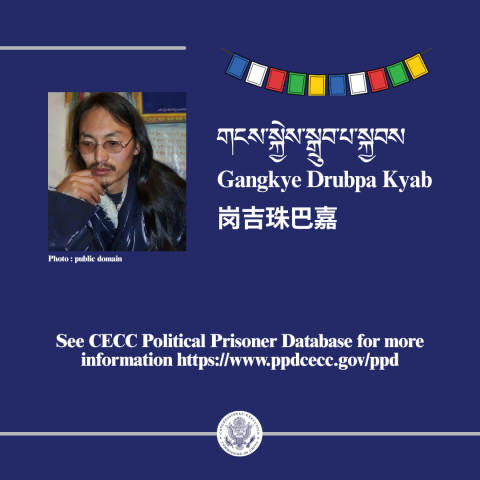
Information emerged in April 2026 that Tsering Drolma and Gangkye Drubpa Kyap were in critical condition, as their injuries due to torture were exacerbated by years of inadequate medical care in prison. Rights advocacy groups called for them to receive urgent medical attention and for the international community to pressure China to fulfill its legal obligations to uphold prisoners’ rights and ensure their welfare in custody.