China Monitor #8
A publication to keep Members of Congress and the public informed about critical human rights and legal developments in China
October 22, 2026
Contents
- Xinjiang Uyghur Autonomous Region: PRC Responds to UFLPA Entity List Additions
- Tibet: PRC Responds to Disaster with Narrative Control
- Rule of Law Developments: Perpetuation of a Hostile Environment for Rights Lawyers
- Rule of Law Developments: New Exit Regulations Formalize Longstanding Restrictions
- Technology and Human Rights: PRC Research and Influence Operations Targeting U.S. Political Debate
- Highlighted Political Prisoner Case—Joshua Wong Chi-fung (黃之鋒)
Xinjiang Uyghur Autonomous Region: PRC Responds to UFLPA Entity List Additions
Beijing is making clear that enforcing U.S. laws against forced labor can carry a price for American companies. After the Department of Homeland Security (DHS) significantly expanded the Uyghur Forced Labor Prevention Act (UFLPA) Entity List this August, the PRC retaliated by blacklisting six U.S. entities, including some entities linked to forced-labor mitigation and supply chain analysis, demonstrating the precarious business environment for multinational companies doing business with the PRC. DHS recently added 43 entities to the UFLPA Entity List, a 30-percent increase in the number of listed entities. The UFLPA applies a rebuttable presumption that any goods produced by the listed entities are made with forced labor. The 43 sanctioned entities include companies based both within the Xinjiang Uyghur Autonomous Region (XUAR) and those based in Chinese provinces outside the XUAR.
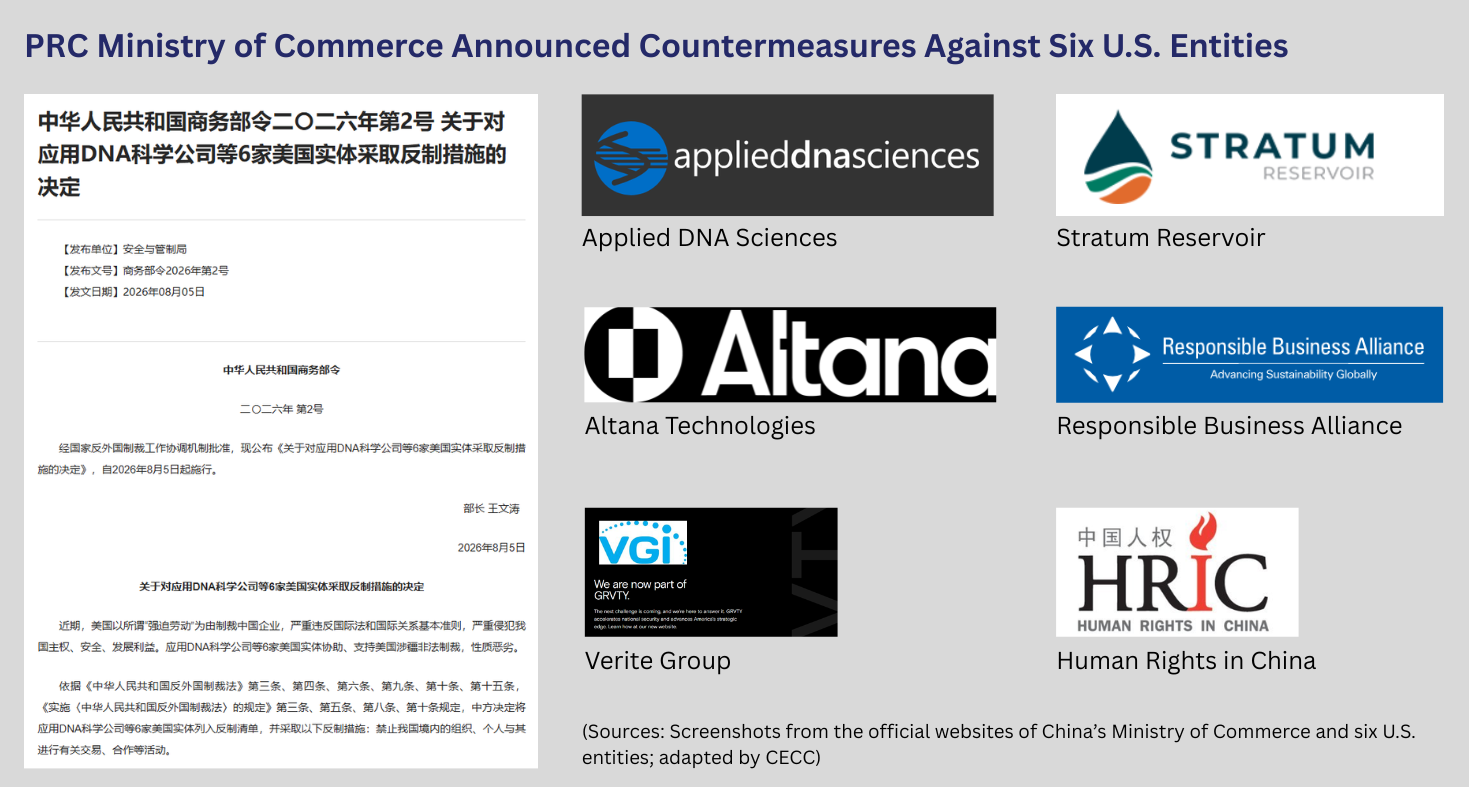
Shortly after DHS announced the UFLPA Entity List additions, the PRC’s Ministry of Commerce (MOFCOM) criticized the list expansion and announced countermeasures that included blacklisting six U.S. entities—Applied DNA Sciences, Stratum Reservoir, Altana Technologies, the Responsible Business Alliance, Verité Group, and Human Rights in China. MOFCOM claims that the six entities, several of which deal with supply chain tracing and due diligence, labor-risk analysis, and labor and human rights advocacy, “assisted and supported the illegal U.S. sanctions related to Xinjiang.” MOFCOM also stated that the PRC’s countermeasures were in line with Articles 3, 4, 6, 9, 10, and 15 and Articles 3, 5, 8, and 10, of the Anti-Foreign Sanctions Law and Provisions on the Implementation of the Anti-Foreign Sanctions Law, respectively.
The PRC has displayed an ongoing pattern of expanding and fortifying its legal toolkit to impose retaliatory sanctions and penalties on entities it deems discriminatory against Chinese entities and supply chains. On top of the Anti-Foreign Sanctions Law and the provisions implementing the law, in April 2026, the PRC’s State Council issued two administrative regulations, the Provisions on Industrial and Supply Chain Security (Supply Chain Provisions) and the Countering Unjustified Extraterritorial Jurisdiction Regulations, that create further restrictions and penalties for multinational companies operating in the PRC. These regulations often contradict U.S. and European standards for entities that conduct product origin tracing, supply chain mapping, due diligence, and compliance audits, making it nearly impossible to comply with both. Legal experts observe that the regulations place multinational companies in a position in which complying with the United States’ regulations, such as the UFLPA’s import restrictions, could lead to violations of the PRC’s regulations, resulting in penalties.
Tibet: PRC Responds to Disaster with Narrative Control
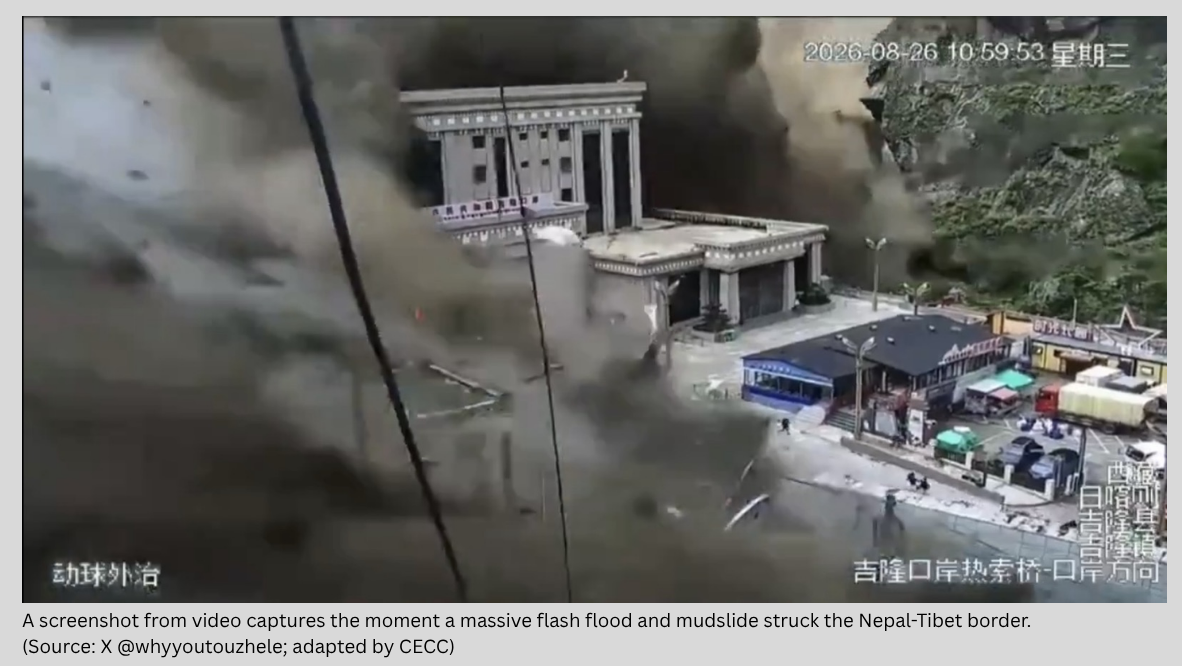
The PRC response to the August 26 mudslide and flooding in Kyirong (also Gyirong; Chinese: Jilong) county on the Tibet Autonomous Region’s (TAR) border with Nepal exemplifies China’s emphasis on narrative control following natural disasters and accidents. Initial videos of the destruction were quickly censored, foreign journalists were barred from reporting on the ground, and at least ten people who questioned the official death toll were punished.
With independent reporting suppressed, only the government’s narrative was allowed to persist. Official reports emphasized Xi Jinping’s leadership and the efforts of search and rescue personnel, while obscuring the scale of the destruction. Chinese authorities have not issued an announcement of the death toll since September 6, when they acknowledged 43 deaths and 519 missing persons. Meanwhile, based on an estimate from a local resident quoted by Radio Free Asia, 800 people may have died at the Kyirong border checkpoint alone. Reporters Without Borders reported that the Nepali police website, which provided updates on the disaster, was blocked in mainland China. Authorities also suppressed eyewitness accounts, censoring social media posts and preventing journalists from interviewing victims’ families.
While these restrictions may seem heavy-handed after a natural disaster for which the government bears no obvious responsibility, similar controls have become the standard response to disasters and accidents under Xi Jinping, including the 2021 floods in Zhengzhou, Henan province and the 2025 earthquake in the TAR. Such efforts correspond with broader PRC campaigns for online information control, including “Clean Internet 2026,” which punishes supposed “rumors” that contradict government narratives, and the “Clear and Bright” campaign, which targets speech that authorities claim promotes “fear and anxiety” or amplifies “pessimism and negativity.” Applying these campaigns to natural disasters reveals the Chinese Communist Party’s concern that expressions of popular sentiment—even public grief—could spiral into dissent and demands for transparency.
Coverage of the mudslide also shows how these campaigns have narrowed the space for journalism in China. China Media Project reported that even outlets once known for investigative journalism, such as Southern Metropolis Daily, simply repeated the government announcement. When foreign journalists were finally permitted to enter the TAR on a government-sponsored tour on September 5, they met with government officials and rescue workers, but not with any survivors. This pattern of suppressing journalism, censoring online speech, and punishing those who disregard controls highlights the reality of expression rights under Xi Jinping—submit to the official narrative, or stay silent.
Rule of Law Developments: Perpetuation of a Hostile Environment for Rights Lawyers
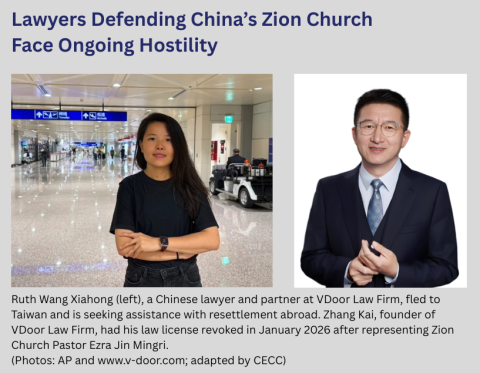
In early September, rights lawyer Ruth Wang Xiahong (王夏红) sought resettlement outside China amid concerns over her personal safety, as PRC authorities increasingly institutionalize control over the legal profession. In a recent policy document, PRC authorities describe the PRC Law on Rule-Based Governance Propaganda and Education as a pivotal tool for implementing Xi Jinping’s ideology. The law obligates legal service providers to engage in propaganda and imposes civil, administrative, and criminal liabilities for non-compliance. Authorities also amended the PRC Lawyers Law in August, elevating into national law some requirements that previously appeared in lower-level Ministry of Justice measures. The amended law requires that Party organizations be established within law firms and that Party activities be conducted therein, and makes support for CCP leadership and China’s socialist rule of law a statutory qualification for lawyers.
Ruth Wang is a partner at VDoor Law Firm and served on the legal team providing representation to members of the Beijing-based Zion Church who were detained in October 2025 by PRC authorities reportedly in violation of their right to practice their religion. PRC authorities had repeatedly pressured her and her colleagues to close the law firm, additionally warning that the government would forcibly close it if they refused. Authorities again contacted Wang while she was on vacation with her family in Japan, which prompted her to travel to Taiwan to seek protection.
Wang’s experience is an example of the CCP’s ongoing efforts to undermine lawyers’ autonomy, which include the “709 Crackdown” that began on July 9, 2015, in which over 300 lawyers and activists were affected. As noted by Chinese Human Rights Defenders, “Authorities have stripped at least 20 [rights] lawyers of their licenses and sanctioned 26 more in the years since the 2015 crackdown, including forcing lawyers to leave their law firms due to official pressure, depriving them and their families of income.” Among them is the founder of VDoor Law Firm, Zhang Kai, whose law license was revoked in January 2026 while he was representing Zion Church founder Ezra Jin Mingri.
Rule of Law Developments: New Exit Regulations Formalize Longstanding Restrictions

Pastor Cao Sanqiang (曹三强, “John Cao”) remains subject to an exit ban more than two years after completing a seven-year prison sentence in China in March 2024. Since his release, Cao has repeatedly applied for a passport in Changsha municipality, but officials have not explained why he is barred or for how long. Diagnosed with late-stage prostate cancer in April 2026, Cao hopes to travel to the United States for treatment and family reunification. His criminal judgment imposed seven years in prison and a fine but no exit ban. ban. Notably, Cao is a U.S. lawful permanent resident for almost 40 years. The Commission has previously documented exit bans imposed on U.S. citizens and residents, including Gao Zhen’s family; the new regulations may also affect Americans subject to such restrictions.
The Exit-Entry Administration Law, in effect since 2013, allows authorities to interdict Chinese citizens whose departure “may endanger national security or interests.” Rights lawyers, dissidents, religious figures, ethnic minorities, and relatives of critics living overseas or in China have faced such restrictions. In 2021, rights activist Guo Feixiong (郭飞雄, also known as Yang Maodong, 杨茂东) was stopped at the airport in Shanghai while trying to visit his critically ill wife in the United States. Authorities said he was suspected of “endangering national security.” His wife died in January 2022 before they could reunite. Guo was later sentenced in 2023 to eight years in prison for “inciting subversion.”
New State Council regulations, effective September 15, 2026, further clarify and expand this system of exit control. Article 6 of the new regulations requires written notice of an exit ban, including the reason for it and its legal basis. But officials may withhold that information when disclosure could “affect national security or a criminal investigation.” However, because national security is often the stated ground in these cases, including Guo’s, affected individuals are left languishing, not knowing the reason for, or the duration of, the ban.
Other provisions extend the system’s potential reach. Chinese citizens given administrative detention for fraudulently obtaining travel documents or illegally entering or leaving China may face exit bans of six months to three years. Similar restrictions apply to Chinese citizens whose illegal or criminal conduct abroad harms “national security or interests.” Exit bans may also be imposed for export control or technology import-export that threatens “national industrial or technological security,” impacting people engaged in cross-border business or technology and potentially impacting overseas activists.
These provisions raise concerns regarding freedom of movement, both for Chinese and foreign citizens. By expanding exit restrictions, the PRC government is making the freedom to leave China increasingly dependent on official permission rather than individual rights.
Technology and Human Rights: PRC Research and Influence Operations Targeting U.S. Political Debate
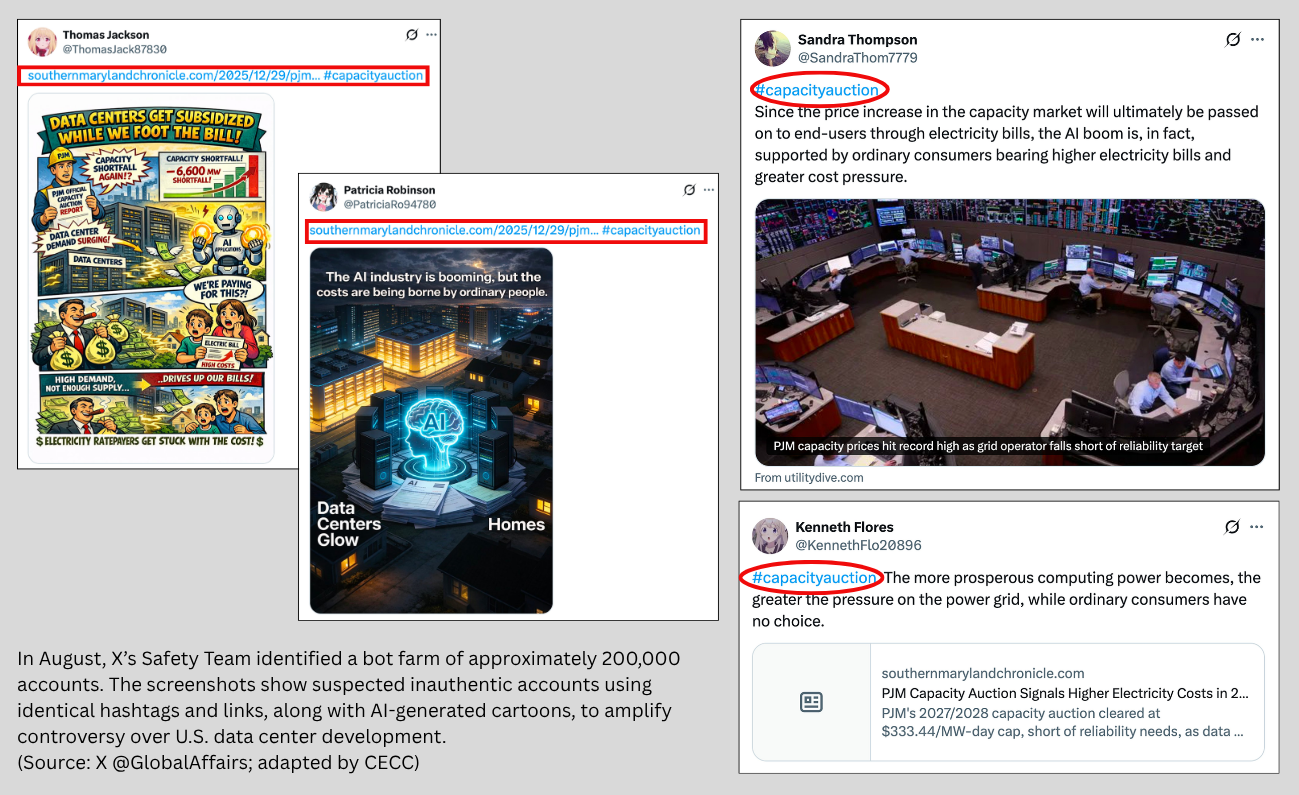
During a recent investigation into suspected People’s Republic of China’s (PRC) influence operations on X, the X Safety Team identified 200 out of 200,000 bot accounts attempting to manipulate political debate in the U.S.. The posts concerning the cost of artificial intelligence (AI) data centers illustrate how the PRC is using AI to influence divisions and political debate in the U.S. and not just “Tell China’s Story Well.” Beyond AI-generated images and amplified messages, PRC state and Party linked researchers have also been examining methods to successfully influence U.S. political debates and advance PRC objectives.
The Chinese Academy of Social Sciences (CASS), the PRC’s full ministerial-level think tank under the State Council that also reports to the CCP Central Committee, has published research on how to communicate with the American public. One 2024 article in an academic portal sponsored by CASS promotes the spread of the PRC’s “whole-process people’s democracy,” which is a concept used domestically to legitimize its governance model, and internationally to deflect criticism of its human rights record. The article proposed reaching Generation Z using pop culture and ostensibly apolitical subjects, recruiting opinion leaders, including young ethnic Chinese, and expanding outreach through podcasts, Reddit, and Quora. It argued that young people’s impressions of the PRC and CCP could eventually affect their countries’ policies toward the PRC. Another CASS-supervised journal tested whether the appearance of AI-generated virtual presenters affects how they evaluate independent and official media content related to the PRC’s national and technological image. The researcher discovered that AI-generated virtual presenters having American or European identities resulted in a more positive and credible evaluation of the PRC than presenters resembling East Asian identities.
PRC educational institutions have also played a role in advancing strategies and ideas to interfere with U.S. political speech. In 2025 a presenter from a PRC state lab affiliated with Huazhong University of Science and Technology reportedly identified “precision targets” in the U.S. for communication concerning technological strengths of the PRC and the United States.Tsinghua University, a top-tier school, recently republished a 2024 study of the U.S. election that recommended tailoring visual narratives on social media to local geographic regions to highlight PRC policy propaganda. These examples demonstrate that PRC institutions are studying the same vulnerabilities that covert actors exploit. Together, they reveal a PRC-sanctioned discussion among experts about how best to promote PRC goals by mimicking authentic American speech, responding to genuine local concerns, and entering political debates through messengers designed to appear familiar and credible.
Highlighted Political Prisoner Case—Joshua Wong Chi-fung (黃之鋒)
On September 2, Joshua Wong Chi-fung (黃之鋒) pleaded guilty to “collusion with a foreign country or with external elements to endanger national security,” a charge that could add years to the prison term he is already serving. CECC chairs condemned the proceedings, saying Hong Kong’s increasingly compromised courts were being used to “cloak repression in the appearance of law.” Wong was charged under the National Security Law enacted in June 2020, based on allegations that he sought the imposition of foreign sanctions on Hong Kong and the People’s Republic of China (PRC).
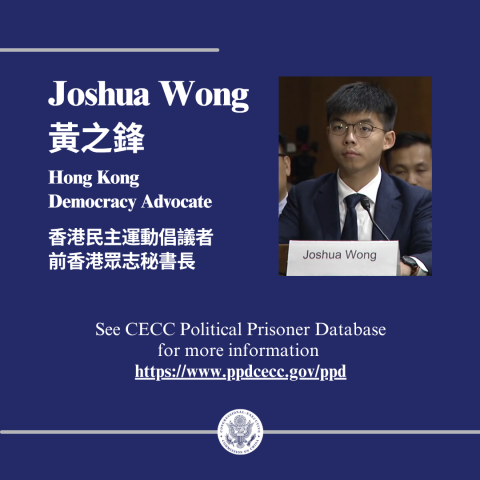
In June 2025, Hong Kong police arrested Wong on the collusion charge while in prison, where he was already serving a four-year, eight-month sentence for “subversion” tied to the 2020 primary election. He had been remanded since 2020 on previous sentences for his involvement with the 2019 extradition protests. Wong has not yet been sentenced, but the “collusion” charge carries a sentence of 3 to 10 years, or life imprisonment in especially “grave” cases.
Joshua Wong has been arrested at least seven times in connection with his activism. In 2011, while a teenager, he co-founded the student activist group Scholarism, which sought to resist influence by the Chinese government in Hong Kong’s education policy. He later co-founded Demosistō, a political group that promoted development of civil society and democratic legislation. He was first arrested in September 2014 in connection with the “Occupy Central” movement advocating for universal suffrage. Originally sentenced to community service, he was later targeted by the Secretary for Justice, who filed an application for his rearrest in 2017. Since that time, Wong has been repeatedly detained by authorities for involvement in Hong Kong democratic movements.
Hong Kong authorities, now operating with little independence from the PRC and its ruling Chinese Communist Party, are treating Joshua Wong’s case as an exemplar for the prosecution of political prisoners, seeking to deter and ultimately quash any remaining opposition. He stands alongside media entrepreneur and democracy advocate Jimmy Lai Chee-ying (黎智英) as an enduring symbol of resistance in the face of repression and as a particular target of authorities’ ire. Lai, who is 78 years old and reportedly in poor health, was sentenced to 20 years’ imprisonment on national security charges in February 2026. In the lead-up to Chinese leader Xi Jinping’s state visit in September, CECC Commissioners held a hearing calling for Jimmy Lai’s release and introduced the Jimmy Lai Hong Kong Political Prisoner Accountability Act of 2026. The Commission held a second hearing focused on prisoners unjustly held in the PRC and will continue to forcefully advocate for their freedom and the freedom of all political prisoners in China.